 ChipApex | Global Electronic Components Supplier

SEARCH
Search Product
Search Post
— IC芯片 | 连接器 | 传感器 | 被动器件 —
Search productSearch post
— IC芯片 | 连接器 | 传感器 | 被动器件 —
Consult the customer manager about the wholesale price.
consultation hotline:86-132-6715-2157
email:[email protected]
Contact the product manager for consultation. One-stop consultation is available.
Do you want a lower wholesale price? Please send us your inquiry and we will reply immediately.
The ASNT5131-KMC is a DC-28Gbps limiting amplifier fabricated in SiGe technology. It features fully differential CML input and output interfaces with internal 50Ohm termination. The device provides low jitter performance and adjustable single-ended output amplitude from 0V to 1.0V via a tuning port with 100MHz bandwidth. It operates on a single +5.0V or -5.0V power supply, consuming 500mW. The component is housed in a custom 24-pin CQFP package with a center heat slug for thermal management.
Verify the specific revision number (Rev. 2.1.2) against the manufacturer's documentation to ensure compatibility with current design requirements. Confirm that the PCB layout supports the required negative or positive supply configuration, as this dictates the necessary AC or DC termination strategies for the I/O ports. Ensure the thermal interface connects the center heat slug to the appropriate ground or power plane.
Select this component when a broadband limiting amplifier with adjustable output amplitude is required for high-speed digital signals up to 28Gbps. The choice depends on the need for low jitter performance and the availability of a single +5V or -5V power rail. Consider the custom 24-pin CQFP package dimensions and the necessity for a dedicated thermal pad connection during the PCB layout phase.
Manufactured by Advanced Science And Novel Technology Company, Inc., the ASNT5131-KMC utilizes Silicon Germanide (SiGe) fabrication for high performance and reliability. It belongs to a family of high-speed RF ICs designed for demanding applications requiring stable operation across varying temperatures. The part is RoHS compliant under directive 2011/65/EU.
No public confirmed substitute part numbers are available in the provided documentation.
Yes, the device can operate with either a negative supply (VEE = -5.0V, VCC = 0V) or a positive supply (VCC = +5.0V, VEE = 0V). Different PCB layouts and termination strategies are required for each configuration.
The differential DC signaling mode is recommended for optimal performance. In this mode, the input signal's common mode voltage must comply with the specified electrical characteristics.
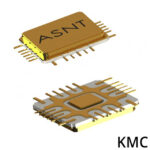 ASNT5131-KMC

The activity of extra discounts on wholesale prices is in full swing…
Please fill in your contact information and we will send you the latest wholesale price list.





