 ChipApex | Global Electronic Components Supplier
SEARCH
Search Product
Search Post
— IC芯片 | 连接器 | 传感器 | 被动器件 —
Search productSearch post
— IC芯片 | 连接器 | 传感器 | 被动器件 —
Consult the customer manager about the wholesale price.
consultation hotline:86-132-6715-2157
email:[email protected]
Contact the product manager for consultation. One-stop consultation is available.
Do you want a lower wholesale price? Please send us your inquiry and we will reply immediately.
The AT42QT1085-MU is an eight-channel QTouch capacitive touch sensor IC with an integrated haptic engine. It operates on a 2.0 V to 5.5 V supply and features a master/slave SPI interface supporting up to 750 kHz clock speeds. The device provides eight dedicated key channels, twelve dedicated bi-directional GPIO pins, and four additional configurable pins that can serve as either keys or GPIOs. It utilizes the QTouchADC measurement method with spread spectrum charge transfer for noise immunity. The package is a 32-pin MLF-32 (5 mm x 5 mm) RoHS compliant form factor.
Verify the specific ordering suffix against official Microchip documentation to confirm package type and tape/reel specifications. Confirm current production status and lifecycle notifications prior to design-in, as component availability may vary by region and distributor.
Select this component when an application requires both multi-key sensing and direct haptic feedback generation without external drivers. Ensure the host system supports SPI communication and has sufficient GPIO resources if utilizing the additional configurable pins alongside the primary touch keys.
This part belongs to the AT42QT10xx series of QTouch sensor controllers from Microchip Technology. It is designed for applications needing robust touch sensing under various environmental conditions while providing immediate physical feedback through its built-in actuator drive capabilities.
Consult Microchip's official product change notifications and discontinuance lists for valid substitute part numbers. Verify pin compatibility and software object protocol alignment before transitioning to alternative models within the same family.
The AT42QT1085 automatically tracks and compensates for slow supply voltage changes due to temperature variations. However, rapid shifts may require a dedicated local voltage regulator to maintain sensitivity.
The CHANGE pin is an open-drain output that asserts low to notify the host microcontroller that a message is waiting to be read via the SPI interface, eliminating the need for continuous polling.
Yes, according to the datasheet pinout descriptions, unused GPIO pins should be left open unless specific circuit requirements dictate otherwise.
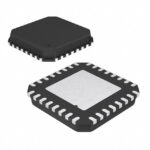 AT42QT1085-MU
The activity of extra discounts on wholesale prices is in full swing…
Please fill in your contact information and we will send you the latest wholesale price list.





