 ChipApex | Global Electronic Components Supplier
SEARCH
Search Product
Search Post
— IC芯片 | 连接器 | 传感器 | 被动器件 —
Search productSearch post
— IC芯片 | 连接器 | 传感器 | 被动器件 —
Consult the customer manager about the wholesale price.
consultation hotline:86-132-6715-2157
email:[email protected]
Contact the product manager for consultation. One-stop consultation is available.
Do you want a lower wholesale price? Please send us your inquiry and we will reply immediately.
The AT42QT1244-AU is a 24-key QMatrix FMEA touch sensor IC from Microchip Technology. It utilizes patented transverse charge-transfer technology with frequency hopping for stable sensing. The device supports up to 24 keys in a matrix layout, featuring individually settable sensitivity via an I2C slave interface operating at speeds up to 400 kHz. It includes self-calibration, auto drift compensation, noise filtering, and Adjacent Key Suppression (AKS). Designed for safety-critical applications, it complies with IEC/EN/UL60730 standards and UL/VDE requirements. Operating voltage ranges from +3 V to 5 V, and the component is housed in a 32-pin 7 × 7 mm TQFP package.
Verify the specific ordering suffix against official documentation to confirm package type and environmental compliance status. Ensure the supplier provides valid traceability documents. Confirm that the component meets RoHS directives as specified in the manufacturer's datasheet. Check for any recent Product Change Notices regarding assembly or material updates before finalizing procurement orders.
Select this component for designs requiring a high number of touch keys within a matrix configuration. It is suitable for applications needing robust noise immunity through frequency hopping and AKS. Consider the power supply requirements of 3 V to 5 V and the need for a clean LDO regulator. Evaluate panel thickness constraints, which support up to 50 mm glass or 20 mm plastic depending on key size.
The AT42QT1244 belongs to the AT42QT1xxx series of capacitance touch sensor ICs by Microchip Technology. It is part of the QMatrix family designed for complex keypad layouts. The AU suffix denotes the 32-pin TQFP package variant. This series integrates advanced signal processing to enable reliable touch detection in electrically noisy environments common in household appliances.
Consult the official Microchip product selector tool for verified cross-references. The AT42QT1245 is a related 24-key device but uses SPI interface and different packaging. Verify pinout compatibility and software register mapping differences when considering alternatives.
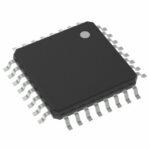 AT42QT1244-AU
The activity of extra discounts on wholesale prices is in full swing…
Please fill in your contact information and we will send you the latest wholesale price list.







