 ChipApex | Global Electronic Components Supplier
SEARCH
Search Product
Search Post
— IC芯片 | 连接器 | 传感器 | 被动器件 —
Search productSearch post
— IC芯片 | 连接器 | 传感器 | 被动器件 —
Consult the customer manager about the wholesale price.
consultation hotline:86-132-6715-2157
email:[email protected]
Contact the product manager for consultation. One-stop consultation is available.
Do you want a lower wholesale price? Please send us your inquiry and we will reply immediately.
The ATA6826C-TUQY-66 is a triple half-bridge driver manufactured by Microchip Technology, designed for driving inductive, capacitive, and resistive loads. It features a DMOS technology with a typical on-resistance of 1.5 ohms. The device operates within a supply voltage range of 4.75V to 5.25V and supports load voltages from 7V to 40V. It provides an output current of 1A per channel with a peak output capability of 1.3A. The component utilizes an SPI interface for control and is housed in a 14-SOIC package (0.154" width). It is rated for operation between -40°C and 150°C junction temperature.
Verify the obsolete status of this specific part number before procurement planning. Confirm that the 14-SOIC package dimensions match your PCB footprint requirements. Ensure the SPI interface compatibility with your host controller is validated. Check for available replacement components due to end-of-life status. Review the datasheet for any specific handling or storage constraints related to the DMOS technology.
Select this component when a triple half-bridge configuration is required for compact designs. It is suitable for applications needing isolated power supply control within the specified voltage ranges. Consider the 1A continuous output current limit for load sizing. The wide operating temperature range makes it appropriate for automotive or industrial environments. Verify that the SPI protocol aligns with the system's communication architecture.
This part belongs to the ATA6826 family of half-bridge drivers from Microchip Technology. It is specifically designed for high-side and low-side switching applications. The family includes variants with different packaging and suffixes. The ATA6826 series is commonly used in automotive lighting and motor control applications. It represents a solution for integrating multiple bridge drivers into a single compact IC.
Public confirmed substitute part numbers are not provided in the source material. Due to the obsolete status, direct replacements should be identified through official Microchip lifecycle notices or equivalent functional alternatives with matching pinouts and electrical characteristics.
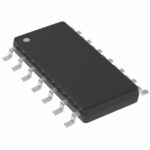 ATA6826C-TUQY-66
The activity of extra discounts on wholesale prices is in full swing…
Please fill in your contact information and we will send you the latest wholesale price list.





