 ChipApex | Global Electronic Components Supplier
SEARCH
Search Product
Search Post
— IC芯片 | 连接器 | 传感器 | 被动器件 —
Search productSearch post
— IC芯片 | 连接器 | 传感器 | 被动器件 —
Consult the customer manager about the wholesale price.
consultation hotline:86-132-6715-2157
email:[email protected]
Contact the product manager for consultation. One-stop consultation is available.
Do you want a lower wholesale price? Please send us your inquiry and we will reply immediately.
The ATF1500A-10JU is a high-performance, electrically erasable complex programmable logic device (CPLD) manufactured by Microchip Technology. It features 32 macrocells and supports up to 36 inputs with a maximum pin-to-pin delay of 10 ns. The device operates at frequencies up to 76.9 MHz externally and 100 MHz internally. It utilizes advanced Flash technology for complete reprogrammability and includes flexible logic macrocells with D/T/Latch configurable flip-flops. The component is housed in a 44-lead Plastic J-leaded Chip Carrier (PLCC) package and is rated for industrial temperature ranges from -40°C to +85°C.
Verify the specific ordering suffix 'JU' corresponds to the 44-lead PLCC package and Industrial temperature range (-40°C to +85°C). Confirm that the design software supports backward compatibility with ATF1500/L if migrating from older devices. Check for any end-of-life notifications or recommended replacement parts such as the ATF1502AS for fast-speed grades.
Select the ATF1500A-10JU when a 44-pin CPLD with 32 macrocells and 10 ns speed grade is required for industrial environments. Ensure the design fits within the 32 macrocell limit and utilizes the global bus architecture effectively. Consider the ATF1500AL variant if lower standby current (3 mA) is critical, noting it may have different availability or pricing structures.
The ATF1500A series belongs to the high-density, high-performance EEPLD family. It offers backward compatibility with ATF1500/L software and hardware. The device integrates logic from various legacy technologies into a single reprogrammable component, simplifying system design and reducing board space requirements.
For fast-speed grades, the ATF1502AS is a pin-compatible replacement. For other speed grades, suggested replacements are available in Green packages. Verify specific pin compatibility and electrical characteristics before substitution.
The maximum external feedback frequency is 76.9 MHz, while the internal feedback frequency can reach 100 MHz.
When the PD pin is driven high, the device enters a power-down mode where supply current drops below 10 mA. All internal logic states and outputs are latched and held, and input transitions are ignored until the PD pin is brought low.
The programmable pin-keeper circuit prevents unused Input and I/O pins from floating to intermediate voltage levels, which reduces unnecessary power consumption and system noise, eliminating the need for external pull-up resistors.
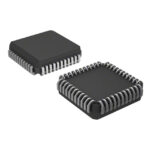 ATF1500A-10JU
The activity of extra discounts on wholesale prices is in full swing…
Please fill in your contact information and we will send you the latest wholesale price list.




