 ChipApex | Global Electronic Components Supplier
SEARCH
Search Product
Search Post
— IC芯片 | 连接器 | 传感器 | 被动器件 —
Search productSearch post
— IC芯片 | 连接器 | 传感器 | 被动器件 —
Consult the customer manager about the wholesale price.
consultation hotline:86-132-6715-2157
email:[email protected]
Contact the product manager for consultation. One-stop consultation is available.
Do you want a lower wholesale price? Please send us your inquiry and we will reply immediately.
The ATF1502ASV-15JU44 is a high-performance, electrically-erasable Complex Programmable Logic Device (CPLD) manufactured by Microchip Technology. It features 32 macrocells with up to 36 inputs and operates within a 3.0V to 3.6V supply range. The device provides a maximum pin-to-pin delay of 15 ns and supports registered operation up to 77 MHz. It utilizes advanced EEPROM technology for in-system programmability via JTAG, offering 10,000 program/erase cycles and 20-year data retention. The component is housed in a 44-lead PLCC package and is rated for industrial temperature ranges from -40°C to +85°C.
Verify the specific ordering suffix against the manufacturer's official documentation to ensure correct package type and temperature rating. Confirm that the procurement source provides genuine components with valid traceability. Check for any recent Product Change Notifications (PCN) regarding packaging or material composition updates. Ensure compatibility with existing JTAG programming hardware if field updates are required.
Select this model when a 3.3V CPLD with 32 macrocells and industrial temperature tolerance (-40°C to +85°C) is required. The 'J' suffix indicates the PLCC-44 package, while 'U44' confirms the specific variant. Choose the -15 speed grade for designs needing a maximum 15 ns propagation delay and up to 100 MHz clock frequency. Consider the ASVL version if lower power consumption is a primary constraint over maximum speed.
This component belongs to the ATF15xx series of high-density CPLDs. It serves as a successor to earlier Atmel PLD families, integrating enhanced routing resources and flexible macrocell architectures. The ATF1502ASV-15JU44 specifically targets applications requiring reliable, reprogrammable logic in harsh environments, leveraging EEPROM technology for non-volatile configuration storage without the need for UV erasure.
The discontinued lead-free ATF1502ASV-15JJ44 was replaced by the ATF1502ASV-15JU44. Both parts share identical electrical specifications and functionality; the replacement offers improved environmental compliance by being both lead- and halide-free. No functional changes are expected during substitution.
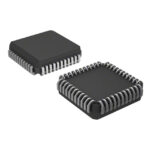 ATF1502ASV-15JU44
The activity of extra discounts on wholesale prices is in full swing…
Please fill in your contact information and we will send you the latest wholesale price list.





