 ChipApex | Global Electronic Components Supplier
SEARCH
Search Product
Search Post
— IC芯片 | 连接器 | 传感器 | 被动器件 —
Search productSearch post
— IC芯片 | 连接器 | 传感器 | 被动器件 —
Consult the customer manager about the wholesale price.
consultation hotline:86-132-6715-2157
email:[email protected]
Contact the product manager for consultation. One-stop consultation is available.
Do you want a lower wholesale price? Please send us your inquiry and we will reply immediately.
The ATF16LV8C-10JU is an Electrically Erasable CMOS Programmable Logic Device (EEPLD) manufactured by Microchip Technology. It features a high-performance architecture with a maximum pin-to-pin propagation delay of 10 ns and operates within a supply voltage range of 3.0V to 5.5V. The device contains eight macrocells, each allocated eight product terms, supporting complex logic functions. It includes a programmable power-down mode option that reduces supply current to less than 5 µA when activated. The component utilizes advanced Flash technology for reprogrammability and offers 2,000V ESD protection.
Verify the ordering suffix 'U' indicates Green Package options which are Pb/Halide-free and RoHS compliant. Confirm the package type corresponds to the 'J' suffix, representing a 20-lead Plastic J-leaded Chip Carrier (PLCC). Ensure the speed grade matches the -10 designation for 10 ns performance. Check for industrial temperature rating (-40°C to +85°C) compatibility with system requirements.
Select this component for applications requiring low power consumption and high-speed logic processing within a 20-pin footprint. The ATF16LV8C-10JU is suitable where industrial temperature stability is required. Consider the 8 macrocell capacity for logic complexity. Verify interface compatibility with 3.0V to 5.5V systems. Evaluate if the specific PLCC package fits the PCB layout constraints.
The ATF16LV8C series belongs to the EEPLD category, utilizing electrically-erasable Flash memory technology. This specific part number represents the industrial temperature variant with 10 ns speed grade in a PLCC package. It is part of a broader family including commercial variants and different speed grades like the -15 model. The device supersedes older PAL technologies while maintaining pin compatibility.
ATF16LV8C-10JC
Pin 4 can be configured as a programmable power-down control pin. When configured as such, setting the pin high drops supply current to less than 5 µA. If power-down is not needed, it functions as a logic input.
Registers reset to the low state during power-up when VCC crosses the reset voltage (VRST). This ensures registered outputs are high on power-up, aiding state machine initialization, provided VCC rise is monotonic and clock signals remain stable.
The maximum operating frequency depends on the feedback configuration. For no feedback, it is 83.3 MHz. With internal feedback, it is 50 MHz, and with external feedback, it is 45.5 MHz.
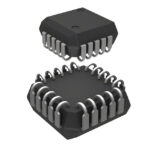 ATF16LV8C-10JU
The activity of extra discounts on wholesale prices is in full swing…
Please fill in your contact information and we will send you the latest wholesale price list.






