 ChipApex | Global Electronic Components Supplier
SEARCH
Search Product
Search Post
— IC芯片 | 连接器 | 传感器 | 被动器件 —
Search productSearch post
— IC芯片 | 连接器 | 传感器 | 被动器件 —
Consult the customer manager about the wholesale price.
consultation hotline:86-132-6715-2157
email:[email protected]
Contact the product manager for consultation. One-stop consultation is available.
Do you want a lower wholesale price? Please send us your inquiry and we will reply immediately.
The ATF16V8C-5JC is a high-performance electrically-erasable programmable logic device (EE PLD) manufactured by Microchip Technology. It utilizes EECMOS Flash memory technology and features a maximum pin-to-pin delay of 5 ns. The component operates within a commercial temperature range of 0°C to +70°C with a supply voltage of 5V ± 5%. It includes an optional pin-controlled power-down mode that reduces current consumption to less than 100μA. The device incorporates input and I/O pin-keeper circuits, eliminating the need for internal pull-up resistors.
Verify package type compatibility during procurement. The suffix 'J' indicates a 20-lead Plastic J-leaded Chip Carrier (PLCC). Confirm RoHS compliance status as ordering codes ending in 'U' or 'X' explicitly imply lead-free packaging, whereas standard suffixes may differ. Ensure design files account for the specific speed grade and temperature range requirements.
Select this part when a 5 ns maximum delay is required for commercial applications (0°C to +70°C). For industrial temperature ranges (-40°C to +85°C), consider downgrading one speed grade from the 'I' to the 'C' device and de-rating power by 30%. Pin 4 can be configured as a power-down control input; if unused, it functions as a standard logic input.
The ATF16V8C belongs to the Atmel ATF16V8C series of high-performance EE PLDs. This architecture supports three modes: registered, complex, and simple, allowing emulation of various PAL devices such as 16L8, 16H8, and 16P8. The device offers eight macrocells with dedicated product terms for flexible logic implementation.
ATF16V8C-7JC is a slower variant (7.5 ns delay) available in the same PLCC package for commercial temperature ranges.
In power-down mode, all output data and internal logic states are latched and held. Registered and combinatorial outputs remain valid, while outputs previously in a high-Z state remain high-Z.
The pin-keeper circuits hold the previous value of each pin even when not driven externally. This prevents pins from floating to indeterminate levels and reduces system power by avoiding DC current associated with pull-up resistors.
Yes, the universal architecture allows it to emulate many 20-pin PAL devices across registered, complex, and simple modes, including subsets like 16R8, 16L8, and 10L8.
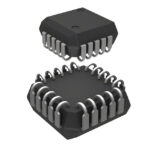 ATF16V8C-5JC
The activity of extra discounts on wholesale prices is in full swing…
Please fill in your contact information and we will send you the latest wholesale price list.





