 ChipApex | Global Electronic Components Supplier
SEARCH
Search Product
Search Post
— IC芯片 | 连接器 | 传感器 | 被动器件 —
Search productSearch post
— IC芯片 | 连接器 | 传感器 | 被动器件 —
Consult the customer manager about the wholesale price.
consultation hotline:86-132-6715-2157
email:[email protected]
Contact the product manager for consultation. One-stop consultation is available.
Do you want a lower wholesale price? Please send us your inquiry and we will reply immediately.
The ATF20V8B-15PC is a high-performance electrically-erasable programmable logic device (PLD) utilizing CMOS Flash memory technology. It features 24 pins in a Plastic Dual Inline Package (PDIP), providing 18 inputs and 8 bi-directional I/Os with 8 macrocells. The maximum pin-to-pin propagation delay is 15 ns, supporting an external feedback frequency of up to 45 MHz. Operating at a nominal 5V supply, it draws 60 mA standby current and 90 mA active current. The device supports registered, complex, and simple modes for PAL emulation.
Verify the ordering suffix 'PC' corresponds to the 24-lead Plastic Dual Inline Package (PDIP). Confirm the temperature range matches the application requirements, as standard commercial parts operate from 0°C to 70°C while industrial variants are designated with an 'I' suffix. Ensure programming equipment supports the specific Flash architecture and voltage levels defined in the datasheet.
Select this component when a 15 ns speed grade is sufficient for the target clock frequency. The device offers three architectural modes; ensure the design compiler is configured correctly to utilize registered or combinatorial outputs as needed. Power consumption varies significantly between modes and switching activity; verify that the 90 mA active current draw fits within the system's power budget.
This part belongs to the ATF20V8B family of high-performance EE PLDs. It serves as a drop-in replacement for legacy GAL and PAL devices, specifically emulating the 20R8 family. The Flash technology allows for reprogramming without UV erasure, offering higher reliability and lower power options compared to earlier EPROM-based PLDs.
Public confirmed substitute part numbers: ATF20V8B-15PI (Industrial Temp), ATF20V8B-15PU (Green/Lead-free Industrial).
The 'PC' suffix indicates a 24-lead, 0.300-inch wide Plastic Dual Inline Package (PDIP).
Yes, in Registered Mode, the ATF20V8B can be programmed to emulate 20R8, 20RP8, 20R6, and similar registered PAL devices.
The maximum external feedback frequency is 45 MHz.
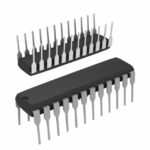 ATF20V8B-15PC
The activity of extra discounts on wholesale prices is in full swing…
Please fill in your contact information and we will send you the latest wholesale price list.





