 ChipApex | Global Electronic Components Supplier
SEARCH
Search Product
Search Post
— IC芯片 | 连接器 | 传感器 | 被动器件 —
Search productSearch post
— IC芯片 | 连接器 | 传感器 | 被动器件 —
Consult the customer manager about the wholesale price.
consultation hotline:86-132-6715-2157
email:[email protected]
Contact the product manager for consultation. One-stop consultation is available.
Do you want a lower wholesale price? Please send us your inquiry and we will reply immediately.
The ATF22V10C-7SX is a high-performance Electrically Erasable Programmable Logic Device (EEPLD) manufactured by Microchip Technology, originally designed by Atmel. It utilizes advanced Flash memory technology to provide reprogrammability with 100% testing and high reliability. The device features 10 macrocells and supports up to 10 I/O pins. It operates at a maximum propagation delay of 7.5 ns and a maximum frequency of 125 MHz. Designed for commercial applications, it functions within a temperature range of 0°C to 70°C using a single 5V power supply.
Verify the package type corresponds to the 'S' suffix, indicating a 24-lead Plastic Gull Wing Small Outline (SOIC). Confirm that the component meets RoHS compliance requirements if lead-free materials are necessary for the assembly process. Ensure the design file compiler mode is set correctly to enable or disable the power-down feature as required by the specific application logic.
Select this part for commercial temperature environments ranging from 0°C to 70°C. The 7.5 ns delay suits moderate-speed digital logic designs. Compare against the -5JX variant for faster switching or the -10PU variant for lower cost in through-hole applications. Ensure the system voltage remains within the 5V ±5% tolerance specified for commercial grade operation.
This component belongs to the ATF22V10C series of EEPLDs. It is backward-compatible with the Atmel ATF22V10B(Q) and AT22V10(L) families. The device integrates 64 bits of user-accessible programmable memory for electronic signature words and includes a security fuse to prevent unauthorized copying of the fuse patterns.
ATF22V10C-7PX (PDIP package)
When the PD pin is driven high, the device enters power-down mode, reducing supply current to less than 100 µA. All output data and internal logic states are latched and held during this period.
The pin-keeper circuits hold the previous value of input and I/O pins when they are not actively driven. This prevents floating inputs and reduces system power consumption without requiring DC current.
Yes, the registers are designed to reset to the low state during power-up. This feature aids in state machine initialization, provided the VCC rise is monotonic and starts below 0.7V.
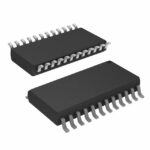 ATF22V10C-7SX
The activity of extra discounts on wholesale prices is in full swing…
Please fill in your contact information and we will send you the latest wholesale price list.





