 ChipApex | Global Electronic Components Supplier
SEARCH
Search Product
Search Post
— IC芯片 | 连接器 | 传感器 | 被动器件 —
Search productSearch post
— IC芯片 | 连接器 | 传感器 | 被动器件 —
Consult the customer manager about the wholesale price.
consultation hotline:86-132-6715-2157
email:[email protected]
Contact the product manager for consultation. One-stop consultation is available.
Do you want a lower wholesale price? Please send us your inquiry and we will reply immediately.
The ATMXT224E-ATR is an automotive-grade capacitive touchscreen controller from the maXTouch family, designed for up to 224 channels. It supports true 12-bit multitouch with independent XY tracking for ten concurrent touches and touch size reporting. The device operates on dual-rail power (VDD and AVDD) ranging from 2.7 V to 3.3 V nominal. It features an I²C-compatible slave interface operating at 400 kHz and includes advanced signal processing for noise suppression and drift compensation. The component is qualified to AEC-Q100 Grade 3 standards, ensuring reliability in harsh environments.
Verify the specific ordering suffix against the manufacturer's current documentation to ensure correct package and temperature grade alignment. Confirm that the required bypass capacitors are X7R or X5R types placed within five millimeters of the chip pins. Check for any product change notifications that may affect pinout or electrical characteristics prior to final design approval.
Select this model when a maximum of 224 sensing nodes is required with automotive reliability standards. Ensure the application supports dual-rail power supplies between 2.7 V and 3.3 V. Verify that the host system can accommodate the I²C interface speed and that the sensor layout matches one of the supported matrix configurations. Consider the need for stylus support or glove operation if applicable to the end-use environment.
This component belongs to the Atmel maXTouch MXT224 series, which utilizes QMatrix technology for mutual capacitance sensing. The E variant denotes the automotive grade version, distinguished by its qualification to AEC-Q100 Grade 3 standards compared to commercial variants. The part integrates a dedicated capacitive touch engine and microsequencer coprocessors for efficient signal acquisition and processing.
Direct replacements must match the 48-pin TQFP package and 224-channel capacity. Verify compatibility with existing firmware protocols as the Object Protocol may differ between generations. Ensure the substitute component supports the same dual-rail power requirements and I²C interface specifications without requiring hardware redesign.
The device supports up to ten concurrent touches with independent XY tracking and touch size reporting.
Yes, in extended modes, Y lines Y8 through Y13 can be reassigned as X drive lines, requiring a 100 Ω resistor for modes 21x9 and 22x8.
No, the device contains an internal oscillator and does not require an external clock source.
The device uses the Touch Suppression T42 object to filter out false detections from large body areas like palms or cheeks.
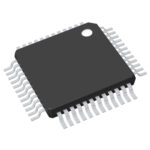 ATMXT224E-ATR
The activity of extra discounts on wholesale prices is in full swing…
Please fill in your contact information and we will send you the latest wholesale price list.





