 ChipApex | Global Electronic Components Supplier
SEARCH
Search Product
Search Post
— IC芯片 | 连接器 | 传感器 | 被动器件 —
Search productSearch post
— IC芯片 | 连接器 | 传感器 | 被动器件 —
Consult the customer manager about the wholesale price.
consultation hotline:86-132-6715-2157
email:[email protected]
Contact the product manager for consultation. One-stop consultation is available.
Do you want a lower wholesale price? Please send us your inquiry and we will reply immediately.
The ATMXT641TD-ABVA1 is an automotive-grade capacitive touchscreen controller from Microchip Technology, operating within a –40°C to +105°C temperature range. It supports up to 32 X and 20 Y lines for a maximum of 640 nodes. The device features I²C interfaces supporting speeds up to 3.4 MHz and SPI up to 8 MHz. Power supplies include nominal 3.3 V for digital, I/O, and analog sections, with an internal voltage pump generating 6.6 V for the X line drive. It is housed in a 100-pin TQFP package measuring 14 × 14 × 1 mm.
Verify the specific ordering suffix against the manufacturer's Product Identification System documentation. Confirm that the 'B' suffix corresponds to the Grade 2 temperature range (–40°C to +105°C) and check if the 'V' indicates a specific tape and reel option or sample type as defined in the official datasheet.
Select this component when an extended industrial/automotive temperature range up to +105°C is required. Ensure the host system can accommodate the 100-pin TQFP footprint. Verify that the application benefits from the integrated hover detection and advanced noise rejection capabilities provided by the maXTouch Adaptive Sensing technology.
This part belongs to the mXT641TD-A family of maXTouch controllers. It shares core sensing engine and node architecture with the mXT641TD-AT variant, differing primarily in the operating temperature grade. The AB designation specifically denotes the wider thermal operating window suitable for harsher automotive environments.
The mXT641TD-AT serves as a functional alternative if the application operates strictly within the –40°C to +85°C range. Both devices share identical pinouts, interface protocols, and software configuration requirements, allowing for potential hardware compatibility if thermal constraints permit.
The controller supports up to 16 concurrent touches tracked in real time.
Yes, it supports single-finger glove touches up to 5 mm thickness and multiple-finger glove touches up to 1.5 mm thickness, subject to stack-up design.
It employs noise suppression technology capable of combating up to 240 Vpp sinusoidal waveform noise between 1 Hz and 1 kHz, and up to 20 Vpp between 1 kHz and 1 MHz.
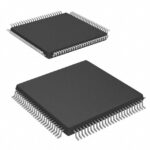 ATMXT641TD-ABVA1
The activity of extra discounts on wholesale prices is in full swing…
Please fill in your contact information and we will send you the latest wholesale price list.





