 ChipApex | Global Electronic Components Supplier
SEARCH
Search Product
Search Post
— IC芯片 | 连接器 | 传感器 | 被动器件 —
Search productSearch post
— IC芯片 | 连接器 | 传感器 | 被动器件 —
Consult the customer manager about the wholesale price.
consultation hotline:86-132-6715-2157
email:[email protected]
Contact the product manager for consultation. One-stop consultation is available.
Do you want a lower wholesale price? Please send us your inquiry and we will reply immediately.
The ATSAMA5D27-SOM1 is a System-on-Module (SOM) developed by Microchip Technology, designed to simplify the integration of industrial-grade Linux systems. It integrates the ATSAMA5D27C-D1G-CU System-in-Package (SiP), which contains an ARM Cortex-A5 MPU running at 500 MHz, with essential peripheral components on a single-sided PCB. The module consolidates power management, non-volatile boot memory, Ethernet PHY, and 1 Gbit DDR2 SDRAM. This integration addresses signal integrity challenges for high-speed interfaces and reduces electromagnetic compatibility (EMC) design complexity. The compact form factor measures 40 mm x 38 mm with a 0.8 mm pitch, facilitating manual soldering and reducing overall PCB complexity.
Verify component authenticity through authorized Microchip distributors or direct channels. Confirm RoHS3 compliance status as specified in current datasheets. Check for specific assembly site variations via PCN documentation if required for supply chain traceability. Ensure handling procedures adhere to moisture sensitivity level requirements during storage and reflow processes.
Select this SOM when minimizing board space and simplifying high-speed DDR/Ethernet layout is critical. It is suitable for designs requiring immediate access to validated Linux software stacks. Consider transitioning to the standalone SiP or MPU if custom peripheral integration beyond the module's scope is needed, leveraging the same underlying processor architecture.
This module is part of the SMART SAMA5D2 series, based on the ARM Cortex-A5 architecture. It serves as a reference implementation for the ATSAMA5D27C-D1G-CU SiP. The SOM allows designers to bypass complex signal integrity issues associated with DDR and PHY routing, accelerating time-to-market for embedded applications requiring robust connectivity and processing power.
For pin-compatible replacements within the SAMA5D2 family, evaluate other MPU variants such as the ATSAMA5D27A-CN, noting that package differences may exist. Direct SOM replacements are limited; consider evaluating newer Microchip SOMs like those based on the SAM9x75 if higher performance or different interface requirements are necessary.
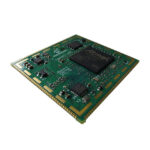 ATSAMA5D27-SOM1
The activity of extra discounts on wholesale prices is in full swing…
Please fill in your contact information and we will send you the latest wholesale price list.






