 ChipApex | Global Electronic Components Supplier

SEARCH
Search Product
Search Post
Search productSearch post
Consult the customer manager about the wholesale price.
consultation hotline:86-132-6715-2157
email:[email protected]
Contact the product manager for consultation. One-stop consultation is available.
Do you want a lower wholesale price? Please send us your inquiry and we will reply immediately.
ATXMEGA128B3-AU is listed in the Microcontrollers range at ChipApex. The manufacturer field lists Microchip Technology. Its product description is IC MCU 8/16BIT 128KB FLSH 64TQFP. Review the specifications below when checking this part for your BOM.
The ATxmega128B3-AU is an 8/16-bit microcontroller from the AVR XMEGA B3 family, featuring a high-performance RISC CPU with single-cycle execution. It integrates 128KB of in-system self-programmable flash memory, including an 8KB boot section, alongside 2KB of EEPROM and 8KB of internal SRAM. The device supports operating frequencies up to 32MHz at 2.7V and includes a USB 2.0 full-speed interface, a two-channel DMA controller, and a four-channel event system. Peripheral connectivity comprises one USART with IrDA support, one TWI, one SPI, and a 16-bit RTC. Analog capabilities include an 8-channel 12-bit ADC and two analog comparators.
Verify the specific ordering suffix 'AU' corresponds to the 64-lead TQFP package and the -40°C to 85°C industrial temperature range. Confirm that the RoHS-compliant, lead-free packaging meets your environmental requirements. Ensure compatibility with the PDI or JTAG programming interfaces for production flashing. Check for any specific lot traceability needs regarding the factory-calibrated signature row data.
Select this component when a balance of moderate flash capacity and robust analog peripherals is required. The inclusion of a native USB interface and LCD driver makes it suitable for user-facing industrial panels. Consider the 32MHz maximum speed and low-power sleep modes for battery-constrained applications. Verify that the 64-pin package fits within the mechanical constraints of the target enclosure.
This part belongs to the Atmel AVR XMEGA B3 microcontroller family, designed for high-performance, low-power embedded applications. It utilizes the enhanced RISC architecture to achieve near 1 MIPS per MHz throughput. The B3 series distinguishes itself with integrated crypto engines, advanced timer features like AWeX, and flexible event routing, positioning it between standard AVR and higher-end ARM-based solutions.
The ATxmega64B3-AU serves as a lower-memory variant within the same pin-compatible family, offering 64KB flash and 4KB SRAM. Other packages such as MH (QFN) or MCU (DRQFN) provide alternative form factors for the same silicon functionality. Cross-family migration to newer XMEGA C or D series may require schematic and software adjustments due to architectural differences.
The device supports both the Program and Debug Interface (PDI), which is a fast two-pin interface, and the IEEE 1149.1 compliant JTAG interface for on-chip debugging and programming.
Yes, the flash memory supports read-while-write capabilities, allowing the application code to continue executing from the application section while the boot loader updates the flash memory.
The ATxmega128B3-AU provides 36 programmable I/O pins accessible across multiple ports, including Port B, C, D, G, M, and R.
Explore related parts through Embedded, Integrated Circuits (ICs), all product categories, ChipApex homepage.
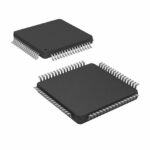 ATXMEGA128B3-AU

The activity of extra discounts on wholesale prices is in full swing…
Please fill in your contact information and we will send you the latest wholesale price list.





