 ChipApex | Global Electronic Components Supplier
SEARCH
Search Product
Search Post
— IC芯片 | 连接器 | 传感器 | 被动器件 —
Search productSearch post
— IC芯片 | 连接器 | 传感器 | 被动器件 —
Consult the customer manager about the wholesale price.
consultation hotline:86-132-6715-2157
email:[email protected]
Contact the product manager for consultation. One-stop consultation is available.
Do you want a lower wholesale price? Please send us your inquiry and we will reply immediately.
The AZ23B36-G3-08 is a dual common anode silicon planar Zener diode array from the Vishay AZ23-G series, housed in a surface-mount SOT-23 package. It provides two independent Zener elements sharing a common anode terminal. The nominal Zener voltage is 36 V with a tight tolerance of ±2%. Electrical characteristics are measured at a test current of 2 mA, yielding a maximum dynamic resistance of 87 Ω and a reverse leakage current of 50 nA at 27 V. The device operates within a temperature range of -55 °C to +150 °C and dissipates up to 300 mW on an FR-4 board.
Verify component authenticity by cross-referencing the ordering code against official Vishay documentation. Confirm that the specific suffix matches the required tape-and-reel packaging format. Ensure the procurement channel sources directly from authorized distributors to guarantee compliance with material categorization and environmental standards.
Select this variant when a precise 36 V breakdown voltage with ±2% accuracy is required in a compact footprint. The dual common anode structure allows for efficient use of board space compared to discrete single diodes. Verify that the operating current aligns with the 2 mA test condition to maintain specified impedance and voltage tolerances.
This component belongs to the AZ23-G series of small signal Zener diodes manufactured by Vishay Semiconductors. The series offers a wide range of standardized voltages graded according to the E24 standard. The 'B' designation specifically indicates the tighter ±2% tolerance band, distinguishing it from the standard ±5% 'C' grade variants within the same package family.
Direct substitutes include other AZ23B36-G3-08 units from Vishay or equivalent dual common anode Zener arrays with matching 36 V nominal voltage, ±2% tolerance, and SOT-23-3 packaging. Verify thermal resistance and power dissipation ratings match the original design constraints before substitution.
The marking code for this device is DF8.
The dual common anode configuration allows two independent Zener diodes to share a single ground or reference connection, reducing the number of required traces and saving PCB area.
The maximum junction temperature (Tj) is 150 °C.
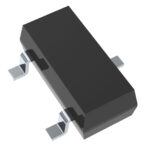 AZ23B36-G3-08
The activity of extra discounts on wholesale prices is in full swing…
Please fill in your contact information and we will send you the latest wholesale price list.




