 ChipApex | Global Electronic Components Supplier
SEARCH
Search Product
Search Post
— IC芯片 | 连接器 | 传感器 | 被动器件 —
Search productSearch post
— IC芯片 | 连接器 | 传感器 | 被动器件 —
Consult the customer manager about the wholesale price.
consultation hotline:86-132-6715-2157
email:[email protected]
Contact the product manager for consultation. One-stop consultation is available.
Do you want a lower wholesale price? Please send us your inquiry and we will reply immediately.
The AZ23B3V6-G3-18 is a dual common anode silicon planar Zener diode array from the Vishay AZ23-G series, housed in a SOT-23 surface-mount package. It provides two independent voltage regulation channels with a nominal Zener voltage of 3.6 V and a tight tolerance of ±2%. The device operates at a test current of 5 mA, dissipates up to 300 mW on a standard FR-4 board, and withstands junction temperatures up to 150 °C. Packaged in tape-and-reel format for automated assembly, it offers high ESD protection and complies with RoHS standards.
Verify the specific ordering suffix against the manufacturer's official documentation to confirm reel specifications and material compliance. Ensure that the procurement channel sources directly from authorized distributors to guarantee component authenticity and traceability throughout the supply chain.
Select this variant when a precise ±2% voltage tolerance is required for dual-channel regulation applications. Confirm that the operating environment remains within the specified -55 °C to +150 °C range and that the thermal design accommodates the 300 mW power dissipation limit on the target PCB footprint.
This component belongs to the broader AZ23-G family of small signal Zener diodes manufactured by Vishay General Semiconductor. The series encompasses various voltage ratings and tolerance grades, all sharing the same compact SOT-23 physical form factor and standardized electrical testing parameters defined in the official datasheet.
Parametric equivalents include other AZ23B3V6 variants such as AZ23B3V6-G3-08 or AZ23B3V6-E3-18, provided the packaging quantity matches the production requirements. Verify that any substitute maintains the identical ±2% tolerance and common anode configuration.
The maximum dynamic resistance (ZZ) measured at the test current of 5 mA is 90 Ω.
Standard versions are not explicitly listed as AEC-Q101 qualified; customers must request specific qualified part numbers directly from Vishay.
The device is marked with the code DD4 on its surface.
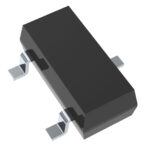 AZ23B3V6-G3-18
The activity of extra discounts on wholesale prices is in full swing…
Please fill in your contact information and we will send you the latest wholesale price list.




