 ChipApex | Global Electronic Components Supplier
SEARCH
Search Product
Search Post
— IC芯片 | 连接器 | 传感器 | 被动器件 —
Search productSearch post
— IC芯片 | 连接器 | 传感器 | 被动器件 —
Consult the customer manager about the wholesale price.
consultation hotline:86-132-6715-2157
email:[email protected]
Contact the product manager for consultation. One-stop consultation is available.
Do you want a lower wholesale price? Please send us your inquiry and we will reply immediately.
The Taiwan Semiconductor AZ23C16 is a dual common anode Zener diode array housed in an SOT-23 surface-mount package. It provides a nominal Zener voltage of 16 V with a tolerance range of 15.3 V to 17.1 V at a test current of 5 mA. The device features a maximum power dissipation of 300 mW and a Zener impedance of 40 Ohms at the specified test current. Maximum reverse leakage current is limited to 100 µA at 12.0 V. The component operates within a junction temperature range of -55°C to +150°C and includes a thermal resistance from junction to ambient of 420°C/W.
Verify the specific ordering suffix (e.g., RFG) against the manufacturer's official documentation to ensure correct packaging and halogen-free status. Confirm RoHS compliance details directly with the supplier, as specifications are subject to change without notice. Ensure the selected variant matches the required tape and reel dimensions for automated assembly processes.
Select this component when a dual Zener array with a 16 V nominal breakdown is required in a compact SOT-23 footprint. Verify that the 300 mW power dissipation rating accommodates the expected operating conditions. Check the 40 Ohm Zener impedance specification against signal integrity requirements. Ensure the design accounts for the 100 µA maximum reverse leakage current at the specified test voltage.
The AZ23C16 belongs to the AZ23C series, which covers Zener voltages from 2.7 V to 51 V. All devices in this family share the same SOT-23 mechanical outline and 300 mW power dissipation capability. The series is designed for automated assembly and offers consistent electrical characteristics across the voltage range, facilitating standardized inventory management for various reference voltage needs.
Cross-reference with other manufacturers' dual common anode Zener arrays in SOT-23 packages. Verify matching electrical parameters, specifically the 16 V nominal voltage, 300 mW power rating, and 40 Ohm impedance. Ensure physical pinout compatibility and thermal performance metrics align with the original design constraints.
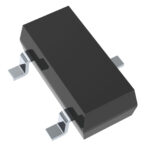 AZ23C16
The activity of extra discounts on wholesale prices is in full swing…
Please fill in your contact information and we will send you the latest wholesale price list.




