 ChipApex | Global Electronic Components Supplier
SEARCH
Search Product
Search Post
— IC芯片 | 连接器 | 传感器 | 被动器件 —
Search productSearch post
— IC芯片 | 连接器 | 传感器 | 被动器件 —
Consult the customer manager about the wholesale price.
consultation hotline:86-132-6715-2157
email:[email protected]
Contact the product manager for consultation. One-stop consultation is available.
Do you want a lower wholesale price? Please send us your inquiry and we will reply immediately.
The AZ23C3V3-7-F is a dual surface mount Zener diode manufactured by Diodes Incorporated, housed in an SOT-23 package. It features a common anode configuration with a maximum power dissipation of 300 mW. The nominal Zener voltage ranges from 3.1 V to 3.5 V at a test current of 5.0 mA. Maximum Zener impedance is specified as 95 Ω at IZT = 5.0 mA and 500 Ω at IZK = 1.0 mA. The typical temperature coefficient is -0.055 %/°C. Operating and storage temperatures range from -65 °C to +150 °C.
Verify the specific ordering suffix against official documentation to confirm commercial versus automotive qualification status. Ensure that the requested quantity aligns with standard tape and reel packaging requirements. Confirm compliance with RoHS and REACH directives based on the latest manufacturer declarations prior to final procurement authorization.
Select this component when a dual Zener array with a common anode is required within a compact SOT-23 footprint. Evaluate the thermal resistance characteristics against the expected ambient temperature conditions to ensure the 300 mW power rating remains within safe operating limits. Verify that the negative temperature coefficient aligns with the circuit's stability requirements.
This device belongs to the AZ23C series of dual surface mount Zener diodes produced by Diodes Incorporated. The series covers a wide voltage range from 2.7 V to 51 V, all sharing the same physical package dimensions and general electrical testing parameters. The product line is designed to provide standardized solutions for voltage regulation and clamping in consumer and industrial electronics.
The DZ23 series serves as the common cathode alternative within the same manufacturer portfolio. Cross-referencing requires verifying pinout compatibility and ensuring the specific voltage tolerance matches the design constraints.
The datasheet does not specify a numerical value for maximum reverse leakage current; it only indicates that the measurement is taken at IR = 0.1 µA.
Yes, the component is qualified to AEC-Q101 standards and offers high ESD protection ratings, making it suitable for automotive environments.
The maximum Zener impedance is 95 Ω at the standard test current of 5.0 mA and increases to 500 Ω at the lower current of 1.0 mA.
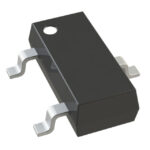 AZ23C3V3-7-F
The activity of extra discounts on wholesale prices is in full swing…
Please fill in your contact information and we will send you the latest wholesale price list.




