ChipApex | Global Electronic Components Supplier
SEARCH
Search Product
Search Post
— IC芯片 | 连接器 | 传感器 | 被动器件 —
Search productSearch post
— IC芯片 | 连接器 | 传感器 | 被动器件 —
Consult the customer manager about the wholesale price.
consultation hotline:86-132-6715-2157
email:[email protected]
Contact the product manager for consultation. One-stop consultation is available.
Do you want a lower wholesale price? Please send us your inquiry and we will reply immediately.
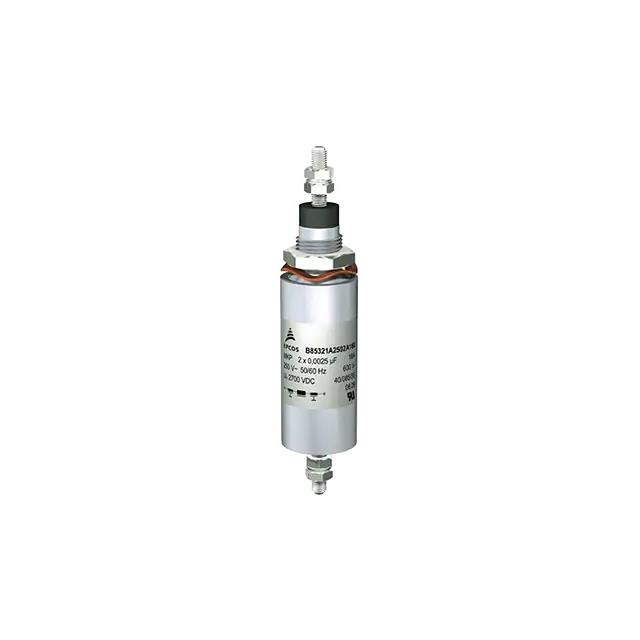
The B85321A2105A301 is a feedthrough capacitor from the EPCOS B85321 series, designed for electromagnetic compatibility (EMC) filtering. It features a metal package and panel mount installation. The component has a rated voltage of 250 V AC at 50/60 Hz or 600 V DC. Its rated current is 75 A, referenced to a 40 °C rated temperature. Physical dimensions are 30 mm diameter by 81 mm height. It operates within a frequency range of 0.01 MHz to 1000 MHz, providing insertion loss between 5 dB and 100 dB.
Verify the specific suffix 'A301' against official TDK/EPCOS documentation to confirm exact physical and electrical specifications. Ensure the required rated current of 75 A aligns with the thermal management design, as values may reduce at higher frequencies or temperatures. Confirm compliance with RoHS3 standards if required by the target application regulations.
Select this component when high current capacity and strong attenuation across a broad frequency spectrum are required. The 250 V AC rating suits standard mains applications, while the 600 V DC option allows for DC bus filtering. Consider the 30 mm diameter and 81 mm height for adequate panel cutout and clearance planning in the final enclosure design.
This part belongs to the B85321 series of feedthrough components manufactured by EPCOS, now part of the TDK Group. These components are specialized for EMC filters, offering reliable performance in suppressing conducted emissions. The series is widely used in industrial and automotive sectors where robust shielding and high current handling are critical for system stability.
Consult official TDK/EPCOS substitution guides for compatible alternatives. Verify that any substitute matches the 75 A rated current, 250 V AC / 600 V DC ratings, and similar physical dimensions to ensure direct fitment without modifying the panel structure.
The component supports operation up to 1000 MHz, covering a wide range of interference frequencies.
The rated current of 75 A is specified at 40 °C. Current values may need reduction at higher ambient temperatures or when operating at 400 Hz.
 B85321A2105A301
The activity of extra discounts on wholesale prices is in full swing…
Please fill in your contact information and we will send you the latest wholesale price list.