 ChipApex | Global Electronic Components Supplier
SEARCH
Search Product
Search Post
— IC芯片 | 连接器 | 传感器 | 被动器件 —
Search productSearch post
— IC芯片 | 连接器 | 传感器 | 被动器件 —
Consult the customer manager about the wholesale price.
consultation hotline:86-132-6715-2157
email:[email protected]
Contact the product manager for consultation. One-stop consultation is available.
Do you want a lower wholesale price? Please send us your inquiry and we will reply immediately.
The B85321A2502Z160 is a feedthrough capacitor from the TDK B85321A series, designed for electromagnetic interference suppression. It features a capacitance of 2500 pF with a tolerance of ±20%. The component is rated for 250 VAC (50/60 Hz) or 600 V DC and supports a maximum DC current of 16 A. Operating temperatures range from -40°C to +85°C. The unit utilizes an axial package with threaded terminals for panel mounting, measuring 16.00 mm in diameter and 60.00 mm in length.
Verify the specific ordering suffix against official TDK documentation to ensure correct capacitance and voltage ratings. Confirm that the threaded terminal dimensions match your panel cutout requirements. Check for RoHS compliance status if required by your manufacturing standards. Ensure the operating temperature range aligns with your system's environmental conditions. Cross-reference the part number with the latest datasheet to avoid discrepancies due to product updates.
Select this component when high-current handling capability is required alongside effective high-frequency noise attenuation. The threaded terminal configuration is suitable for applications requiring mechanical stability on metal panels. Consider the 16 A current rating for power line applications where significant load currents are present. Evaluate the physical dimensions to ensure compatibility with available enclosure space. Verify that the 2500 pF capacitance value meets the specific filtering requirements of the target circuit.
This component belongs to the B85321 series of feedthrough capacitors manufactured by TDK Electronics, formerly known as EPCOS. The series is specifically designed for passive electromagnetic interference suppression in electronic systems. These components are widely used in industrial and automotive applications where reliable noise filtering is critical for system performance and regulatory compliance.
Consult official TDK substitution guides for verified alternatives. Ensure any replacement maintains equivalent current ratings, voltage specifications, and physical mounting dimensions. Verify that substitute components offer comparable frequency response characteristics for effective noise suppression.
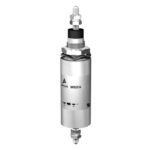 B85321A2502Z160
The activity of extra discounts on wholesale prices is in full swing…
Please fill in your contact information and we will send you the latest wholesale price list.





