 ChipApex | Global Electronic Components Supplier

SEARCH
Search Product
Search Post
— IC芯片 | 连接器 | 传感器 | 被动器件 —
Search productSearch post
— IC芯片 | 连接器 | 传感器 | 被动器件 —
Consult the customer manager about the wholesale price.
consultation hotline:86-132-6715-2157
email:[email protected]
Contact the product manager for consultation. One-stop consultation is available.
Do you want a lower wholesale price? Please send us your inquiry and we will reply immediately.
The BAT54CHMFHT116 is an automotive-grade Schottky barrier diode manufactured by ROHM Semiconductor. It features a dual common cathode configuration housed in a compact SOT-23 (SSD3) surface-mount package. The device supports a maximum repetitive reverse voltage of 30V and an average rectified forward current of 0.2A. Key electrical specifications include a maximum forward voltage of 800mV at 100mA, a peak forward surge current of 600mA, and a maximum reverse current of 2µA. It operates within a junction temperature range up to +150°C and complies with the AEC-Q101 reliability standard for automotive applications.
Verify the component status before integration, as this specific suffix variant may be designated as Not Recommended for New Designs (NRND). Confirm that the ordering part number matches the required automotive grade specifications and package type. Ensure compatibility with existing supply chains given potential lifecycle restrictions. Cross-reference the datasheet for any updates on material compliance or pinout definitions prior to final procurement decisions.
Select this component when designing for automotive environments requiring robust Schottky rectification in a minimal footprint. The dual common cathode arrangement simplifies board layout compared to discrete single diodes. Consider the 30V reverse voltage rating and 0.2A current capacity against the specific load requirements of the target application. Verify thermal management needs given the small package size and operating temperature limits.
This part belongs to ROHM's BAT54 series of Schottky barrier diodes, specifically tailored for automotive use. The 'MFH' suffix typically denotes the specific tape and reel packaging format. It shares the same pinout and package dimensions as other variants in the family, such as the BAT54CHY, facilitating potential design swaps if availability permits.
The BAT54CHYFHT116 is a confirmed substitute with the same pinout and package. It offers active status where the MFH variant may be restricted for new designs. Both parts share identical electrical characteristics and automotive qualifications.
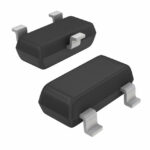 BAT54CHMFHT116

The activity of extra discounts on wholesale prices is in full swing…
Please fill in your contact information and we will send you the latest wholesale price list.





