 ChipApex | Global Electronic Components Supplier

SEARCH
Search Product
Search Post
— IC芯片 | 连接器 | 传感器 | 被动器件 —
Search productSearch post
— IC芯片 | 连接器 | 传感器 | 被动器件 —
Consult the customer manager about the wholesale price.
consultation hotline:86-132-6715-2157
email:[email protected]
Contact the product manager for consultation. One-stop consultation is available.
Do you want a lower wholesale price? Please send us your inquiry and we will reply immediately.
The BAV70 is a dual common cathode switching diode array fabricated in planar silicon technology. It features a compact SOT-23 surface-mount package with three terminals. Key electrical specifications include a maximum repetitive peak reverse voltage of 75 V and a continuous reverse voltage of 70 V. The device supports a maximum average rectified forward current of 215 mA per diode and a repetitive peak forward current of 450 mA. It exhibits a high switching speed with a maximum reverse recovery time of 4 ns. The component operates within a junction temperature range of -55°C to +150°C.
Verify the specific manufacturer source, as the BAV70 designation is utilized by multiple semiconductor producers including Philips, onsemi, and Diotec. Confirm that the datasheet matches the required voltage and current ratings for your design. Ensure the package type corresponds to SOT-23 or TO-236-3 as specified in your schematic. Check for RoHS compliance status if environmental regulations apply to your production environment.
Select this component when a dual diode solution with common cathode topology is required in a small form factor. The low reverse recovery time makes it suitable for high-frequency applications. Compare the 75 V peak reverse voltage rating against your circuit's maximum transient voltages. Consider the thermal dissipation capabilities of the SOT-23 package relative to your expected forward current loads.
The BAV70 belongs to a family of high-speed double diodes designed for general-purpose switching. It is often compared with variants like the BAV99 or BAW56, which share similar pinouts but may differ in internal configurations or voltage ratings. This component represents a standard solution for replacing discrete diode pairs in space-constrained printed circuit board layouts.
The BAV70HY is listed as a direct replacement with the same pinout and package, though it offers an increased reverse voltage rating of 90 V. Verify compatibility with existing PCB footprints when substituting.
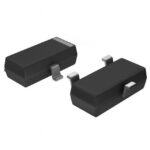 BAV70

The activity of extra discounts on wholesale prices is in full swing…
Please fill in your contact information and we will send you the latest wholesale price list.





