 ChipApex | Global Electronic Components Supplier

SEARCH
Search Product
Search Post
— IC芯片 | 连接器 | 传感器 | 被动器件 —
Search productSearch post
— IC芯片 | 连接器 | 传感器 | 被动器件 —
Consult the customer manager about the wholesale price.
consultation hotline:86-132-6715-2157
email:[email protected]
Contact the product manager for consultation. One-stop consultation is available.
Do you want a lower wholesale price? Please send us your inquiry and we will reply immediately.
The BAV70LT1G is a dual common cathode switching diode manufactured by onsemi in an SOT-23 (TO-236) surface-mount package. It features a maximum reverse voltage of 100 V and a forward current rating of 200 mA per diode. The device supports repetitive peak forward currents up to 1.5 A and non-repetitive surge currents ranging from 0.5 A to 31 A depending on pulse width. Electrical characteristics include a maximum reverse recovery time of 6 ns, a forward voltage of 1.25 V at 150 mA, and a leakage current of 60 µA at 100 V. Total power dissipation reaches 300 mW on an alumina substrate, with an operating temperature range of -55°C to +150°C.
Verify the specific ordering suffix to confirm packaging quantity and tape-and-reel specifications. Confirm that the required application meets AEC-Q101 qualification criteria if automotive compliance is necessary. Ensure thermal management aligns with the specified junction-to-ambient resistance values for the intended PCB substrate type.
Select this component when a dual common cathode arrangement is required in a small footprint. The 100 V reverse voltage rating provides higher headroom compared to standard 70 V variants. Consider the 6 ns recovery time for high-speed digital applications where fast switching is critical. Verify pinout compatibility with existing board layouts using Style 9 configuration.
This device belongs to the BAV70L series of dual switching diodes. It shares the same electrical performance as the BAV70LT3G but differs in shipping quantity. The part is distinct from the BAV70TT1G, which utilizes a different SC-75-3 package and lower voltage rating. It serves as a modern replacement for legacy through-hole or older surface-mount diode arrays.
The device uses SOT-23 Style 9, where Pin 1 is Anode, Pin 2 is Anode, and Pin 3 is Cathode.
Yes, it is AEC-Q101 qualified and PPAP capable for automotive and other applications requiring unique site and control change requirements.
The total device dissipation is 225 mW on an FR-5 board and 300 mW on an alumina substrate at 25°C ambient temperature.
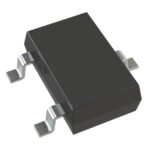 BAV70LT1G

The activity of extra discounts on wholesale prices is in full swing…
Please fill in your contact information and we will send you the latest wholesale price list.





