 ChipApex | Global Electronic Components Supplier
SEARCH
Search Product
Search Post
— IC芯片 | 连接器 | 传感器 | 被动器件 —
Search productSearch post
— IC芯片 | 连接器 | 传感器 | 被动器件 —
Consult the customer manager about the wholesale price.
consultation hotline:86-132-6715-2157
email:[email protected]
Contact the product manager for consultation. One-stop consultation is available.
Do you want a lower wholesale price? Please send us your inquiry and we will reply immediately.
The BC25SC15-04 is a 1-inch (25 mm) high-frequency driver manufactured by Peerless by Tymphany. It features a treated soft dome diaphragm and a neodymium magnet assembly for high output in a compact size. The unit has a nominal impedance of 4 Ohms and a rated power handling of 100 Watts. Its frequency response spans from 1.4 kHz to 20 kHz, with a resonant frequency (Fs) of approximately 1400 Hz. Sensitivity is rated at 93 dB (1W/1m), and it utilizes a polymer faceplate with recessed waveguide loading.
Verify the specific datasheet version before integration, as component specifications may be subject to change without notice. Confirm that the 4-Ohm impedance aligns with your amplifier or crossover network requirements. Ensure mechanical mounting dimensions match your enclosure design. Check for RoHS compliance status if required for your region. Contact the manufacturer or authorized distributors for current availability and lead times.
Select this model when a compact tweeter with high sensitivity and robust power handling is required. The neodymium magnet allows for a smaller magnetic structure compared to ferrite alternatives. The recessed waveguide design aids in dispersion control. Consider the 100W rating for high-power applications. Verify compatibility with existing crossover components designed for 4-Ohm loads.
This driver belongs to the BC series of dome tweeters from Peerless by Tymphany. The series is known for combining advanced acoustic materials with efficient magnetic structures. These drivers are engineered for demanding audio applications requiring clarity and reliability. The brand leverages extensive experience in speaker unit manufacturing to deliver consistent performance across its product line.
No direct public substitute part numbers are confirmed for this specific model. When replacing, ensure the new driver matches the 4-Ohm impedance, 1-inch diameter, and similar sensitivity ratings. Mechanical mounting hole patterns must be verified. Crossover networks may require adjustment due to differences in resonance frequency or impedance curves.
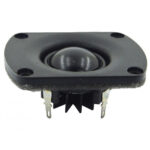 BC25SC15-04
The activity of extra discounts on wholesale prices is in full swing…
Please fill in your contact information and we will send you the latest wholesale price list.






