 ChipApex | Global Electronic Components Supplier
SEARCH
Search Product
Search Post
— IC芯片 | 连接器 | 传感器 | 被动器件 —
Search productSearch post
— IC芯片 | 连接器 | 传感器 | 被动器件 —
Consult the customer manager about the wholesale price.
consultation hotline:86-132-6715-2157
email:[email protected]
Contact the product manager for consultation. One-stop consultation is available.
Do you want a lower wholesale price? Please send us your inquiry and we will reply immediately.
The BC25TG35-04 is a tweeter manufactured by Peerless by Tymphany, designed for high-frequency audio reproduction. It features a 1-inch (25 mm) fabric dome and operates within a frequency range of 2.5 kHz to 20 kHz. The unit has an impedance of 4.28 Ohms and a rated power handling capacity of 100 W. Its self-resonant frequency is 1137.32 Hz, with a sensitivity of 90.2 dBA measured at 1W/1M in a half-space environment. The driver utilizes a ferrite magnet motor structure and employs solder lug terminals for connection.
Verify component authenticity through authorized Peerless by Tymphany distributors or certified suppliers. Confirm that the received unit matches the specific part number BC25TG35-04 and includes original manufacturer documentation. Check for physical integrity of the fabric dome and terminal connections prior to installation. Ensure compliance with relevant environmental standards such as RoHS requirements specified in official datasheets.
Select this component when a compact tweeter with high efficiency and robust thermal handling is required. The 4.28 Ohm impedance and 100 W rating suit applications demanding significant power handling in small form factors. Consider the ferrite motor construction if cost-effective magnetic solutions are preferred over neodymium alternatives. Evaluate compatibility with crossover networks designed for the 2.5 kHz lower limit.
This model belongs to the BC series of tweeters from Peerless by Tymphany, which focuses on providing advanced acoustic solutions for various audio markets. The company integrates proprietary digital signal processing and wireless communication technologies into its product lines. The BC series is engineered for use in home, automotive, and professional audio environments, leveraging extensive expertise in driver design and cabinet manufacturing.
No public confirmed substitute part numbers are available in the provided documentation. Verify mechanical dimensions and electrical parameters against alternative models before substitution.
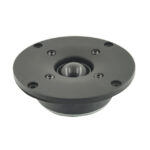 BC25TG35-04
The activity of extra discounts on wholesale prices is in full swing…
Please fill in your contact information and we will send you the latest wholesale price list.






