 ChipApex | Global Electronic Components Supplier
SEARCH
Search Product
Search Post
— IC芯片 | 连接器 | 传感器 | 被动器件 —
Search productSearch post
— IC芯片 | 连接器 | 传感器 | 被动器件 —
Consult the customer manager about the wholesale price.
consultation hotline:86-132-6715-2157
email:[email protected]
Contact the product manager for consultation. One-stop consultation is available.
Do you want a lower wholesale price? Please send us your inquiry and we will reply immediately.
The BC847BSHX is an NPN/NPN general-purpose transistor pair manufactured by Nexperia. It is housed in a SOT363 (SC-88) surface-mount plastic package, providing a compact solution for space-constrained designs. The device features closely matched current gain characteristics between the two internal transistors and exhibits low collector capacitance. Key electrical ratings include a maximum collector-emitter voltage of 45 V and a continuous collector current of 100 mA per transistor. The total power dissipation is rated at 225 mW. The component operates within a temperature range of -55°C to +150°C.
Verify the suffix HX against official Nexperia documentation to confirm specific tape-and-reel packaging parameters and binning requirements. Ensure compatibility with automated pick-and-place equipment specifications for the SC-88 footprint. Cross-reference RoHS compliance status with the latest manufacturer declarations prior to integration into regulated assemblies.
Select this component when dual NPN transistors with matched hFE are required in minimal board area. Compare against single-transistor solutions if isolation is needed. Verify that the 45V VCEO rating meets circuit voltage headroom requirements. Consider thermal management constraints due to the small package size and 225mW total power dissipation limit.
The BC847BSHX belongs to the BC847 series of general-purpose silicon NPN transistors. This series offers multiple gain ranges (A, B, C) and configurations. The BS variant specifically denotes the dual NPN topology in the SOT363 package, complementing the PNP/PNP BC857BS counterpart. It is designed as a drop-in replacement for discrete dual transistor arrangements.
Direct pin-compatible substitutes include the BC847BS from other manufacturers adhering to the SOT363 standard. Verify matching hFE bins and VCEO ratings. Single-transistor equivalents require two units and additional board space. Automotive-grade variants like BC847B-QR offer different qualification standards but may have distinct electrical tolerances.
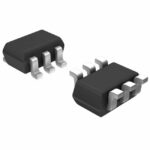 BC847BSHX
The activity of extra discounts on wholesale prices is in full swing…
Please fill in your contact information and we will send you the latest wholesale price list.




