 ChipApex | Global Electronic Components Supplier
SEARCH
Search Product
Search Post
— IC芯片 | 连接器 | 传感器 | 被动器件 —
Search productSearch post
— IC芯片 | 连接器 | 传感器 | 被动器件 —
Consult the customer manager about the wholesale price.
consultation hotline:86-132-6715-2157
email:[email protected]
Contact the product manager for consultation. One-stop consultation is available.
Do you want a lower wholesale price? Please send us your inquiry and we will reply immediately.
The BD9302FP-E2 is a dual-channel synchronous buck converter controller from ROHM Semiconductor, designed for applications requiring two independent regulated outputs. It operates within an input voltage range of 6 V to 18 V and supports adjustable output voltages from 0.8 V to 14.4 V per channel. Each channel delivers a maximum output current of 2 A. The switching frequency is programmable between 200 kHz and 2.5 MHz. The device functions reliably across an operating temperature range of -40 °C to +85 °C and is housed in an HSOP-25 package.
Verify the specific suffix designation against the manufacturer's latest documentation to ensure compatibility with required packaging and environmental standards. Confirm that the component status aligns with current design lifecycle requirements, as availability may be restricted for new designs. Cross-reference pin assignments and thermal characteristics with the official datasheet before finalizing procurement specifications.
Select this component when a compact solution for dual-output voltage regulation is required within a 6 V to 18 V input window. Ensure the application demands a maximum continuous current of 2 A per channel. Verify that the desired switching frequency falls within the 200 kHz to 2.5 MHz range to meet electromagnetic interference and inductor sizing constraints. Confirm that the HSOP-25 package footprint fits the available printed circuit board area.
This part belongs to ROHM's series of integrated FET controllers focused on efficient power management. It serves as a core component in multi-rail power supply architectures where space efficiency and precise voltage control are critical. The dual-channel design reduces the bill of materials compared to using single-channel equivalents for similar power densities.
Consult the manufacturer's official substitution guide for verified alternative part numbers. Ensure any replacement maintains identical pinout configurations and electrical parameters to avoid redesigning the surrounding passive components.
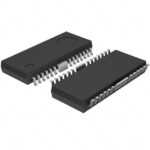 BD9302FP-E2
The activity of extra discounts on wholesale prices is in full swing…
Please fill in your contact information and we will send you the latest wholesale price list.





