 ChipApex | Global Electronic Components Supplier
SEARCH
Search Product
Search Post
— IC芯片 | 连接器 | 传感器 | 被动器件 —
Search productSearch post
— IC芯片 | 连接器 | 传感器 | 被动器件 —
Consult the customer manager about the wholesale price.
consultation hotline:86-132-6715-2157
email:[email protected]
Contact the product manager for consultation. One-stop consultation is available.
Do you want a lower wholesale price? Please send us your inquiry and we will reply immediately.
The Knowles BK-29725-000 is a high-performance, low-noise electret condenser microphone capsule designed for precision audio capture. It features an omnidirectional polar pattern to ensure uniform sound pickup from all directions without directional bias. The component utilizes a back-electret design with a built-in JFET impedance converter for stable signal output. Key electrical specifications include a sensitivity of -42 dB ± 3 dB (referenced to 1V/Pa at 1kHz), a frequency response range of 50 Hz to 16 kHz, and a maximum sound pressure level capability of 120 dB SPL. It operates within a voltage range of 1.5 V to 10 V DC and draws a current of approximately 0.1 mA.
Verify the specific suffix codes on the component marking against official Knowles documentation to confirm exact sensitivity binning and lead finish options. Ensure that the operating voltage supplied to the internal JFET remains within the specified 1.5 V to 10 V DC range to prevent damage or distortion. Confirm mechanical mounting dimensions match the target enclosure design prior to integration.
Select this model when a flat frequency response and wide dynamic range are critical for accurate audio reproduction. Consider the physical size and mounting requirements relative to the application space. Evaluate the need for additional external filtering based on the intended frequency band usage, as the capsule naturally captures frequencies up to 16 kHz.
This component belongs to the broader category of precision electret microphones used in high-fidelity audio applications. It represents a standard solution for engineers requiring reliable, low-noise transducers. The design focuses on minimizing self-noise while maintaining high linearity across the audible spectrum.
Consult official Knowles cross-reference guides for direct equivalents. Verify that any substitute part matches the pinout configuration, sensitivity tolerance, and mechanical footprint to ensure seamless integration without circuit redesign.
The microphone operates effectively within a DC voltage range of 1.5 V to 10 V, with typical applications utilizing 2 V to 5 V for balanced performance.
No, the back-electret design includes permanently charged dielectric material, eliminating the need for external high-voltage polarization supplies.
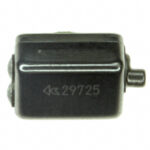 BK-29725-000
The activity of extra discounts on wholesale prices is in full swing…
Please fill in your contact information and we will send you the latest wholesale price list.







