 ChipApex | Global Electronic Components Supplier
SEARCH
Search Product
Search Post
— IC芯片 | 连接器 | 传感器 | 被动器件 —
Search productSearch post
— IC芯片 | 连接器 | 传感器 | 被动器件 —
Consult the customer manager about the wholesale price.
consultation hotline:86-132-6715-2157
email:[email protected]
Contact the product manager for consultation. One-stop consultation is available.
Do you want a lower wholesale price? Please send us your inquiry and we will reply immediately.
The BRT13H is a phototriac output optocoupler featuring a non-zero crossing design. It integrates an AlGaAs infrared LED with a light-sensitive triac in a 6-DIP package. Key electrical parameters include a 5300 Vrms isolation voltage, 800 V off-state voltage (VDRM), and 300 mA RMS on-state current (It RMS). The forward current is rated at 20 mA with a typical forward voltage of 1.1 V. Maximum power dissipation is 600 mW. Operating temperature ranges from -40°C to +150°C.
Verify the specific datasheet revision and RoHS compliance status directly with Vishay Semiconductor Opto Division before procurement. Confirm that the non-zero crossing characteristic aligns with the target application requirements, as this differs from zero-crossing variants. Ensure the DIP-6 through-hole package fits the PCB layout constraints.
Select the BRT13H when precise phase-angle control is required, as its non-zero crossing nature allows triggering at any point in the AC cycle. This distinguishes it from zero-crossing devices which only trigger near voltage peaks. Verify that the 300 mA RMS load current meets the system demands and that the 5300 Vrms isolation is sufficient for the safety standards of the end equipment.
The BRT13H belongs to the BRT13 series of Triac & SCR Output Optocouplers manufactured by Vishay Semiconductors. This series is designed for general-purpose AC switching and isolation tasks. The component utilizes standard DIP-6 packaging suitable for through-hole mounting, providing a robust solution for industrial and consumer electronics requiring galvanic isolation between control and power stages.
For applications requiring zero-crossing behavior instead of phase-angle control, consider the BRT23H. If lower voltage ratings are acceptable, the BRT21H offers a 400 V off-state voltage. Always verify pinout compatibility and thermal characteristics when substituting components within the same family.
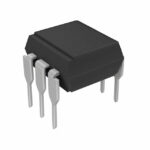 BRT13H
The activity of extra discounts on wholesale prices is in full swing…
Please fill in your contact information and we will send you the latest wholesale price list.






