 ChipApex | Global Electronic Components Supplier
SEARCH
Search Product
Search Post
— IC芯片 | 连接器 | 传感器 | 被动器件 —
Search productSearch post
— IC芯片 | 连接器 | 传感器 | 被动器件 —
Consult the customer manager about the wholesale price.
consultation hotline:86-132-6715-2157
email:[email protected]
Contact the product manager for consultation. One-stop consultation is available.
Do you want a lower wholesale price? Please send us your inquiry and we will reply immediately.
The BT131 is a general-purpose triac designed for bi-directional switching and phase control applications. It features direct interfacing capability with logic level ICs, low power gate drive circuits, and microcontrollers. The device offers high blocking voltage capability of 600 V and supports an RMS on-state current of 1 A. Key electrical parameters include a peak repetitive forward or reverse blocking current of 5.0 mA, a gate trigger current ranging from 5.0 to 10 mA depending on the quadrant, and a gate trigger voltage of 1.5 V. The component operates within a junction temperature range up to +125 °C and is available in TO-92, SOT-223, SOT-89, and SOT-23 packages.
Verify the specific package variant (TO-92, SOT-223, SOT-89, or SOT-23) required for the design, as pin assignments differ between configurations. Confirm that the selected component meets the thermal management requirements for the intended operating junction temperature of +125 °C. Ensure the gate drive circuitry aligns with the specified peak gate power and current limits to prevent device damage during operation.
Select the BT131 when a general-purpose triac with sensitive gate triggering is required for low-power control scenarios. The device is suitable for applications requiring direct interface with microcontrollers due to its low gate trigger voltage and current specifications. Consider the available package options based on board space constraints and thermal dissipation needs, ensuring the chosen footprint matches the PCB layout design.
The BT131 belongs to the family of general-purpose silicon controlled rectifiers (SCRs) and triacs used in AC power control. It is engineered for reliability in consumer electronics and industrial control systems where compact size and simple drive requirements are prioritized. The planar passivation technology ensures consistent performance across varying environmental conditions, making it a standard choice for basic switching tasks.
Substitute parts must match the 600 V blocking voltage and 1 A RMS current ratings. Verify compatibility with existing PCB footprints if using different package types such as SOT-23 or TO-92. Ensure the replacement device supports four-quadrant triggering and has similar gate sensitivity characteristics to maintain original circuit functionality without redesign.
The maximum non-repetitive peak on-state current (ITSM) for the BT131 is 16 A.
Yes, the BT131 is designed to trigger in all four quadrants, allowing for flexible gate drive polarity options.
The critical rate of rise of off-state voltage is specified as 5 V/μs under test conditions of VD=67%VDRM and RGK=1kΩ.
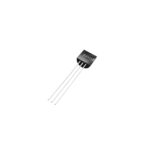 BT131
BT131
The activity of extra discounts on wholesale prices is in full swing…
Please fill in your contact information and we will send you the latest wholesale price list.





