 ChipApex | Global Electronic Components Supplier

SEARCH
Search Product
Search Post
Search productSearch post
Consult the customer manager about the wholesale price.
consultation hotline:86-132-6715-2157
email:[email protected]
Contact the product manager for consultation. One-stop consultation is available.
Do you want a lower wholesale price? Please send us your inquiry and we will reply immediately.
BU8763FV-E2 is listed in the Telecom range at ChipApex. The manufacturer field lists Rohm Semiconductor. Its product description is IC TELECOM INTERFACE SSOP-B16. Review the specifications below when checking this part for your BOM.
The BU8763FV-E2 is a melody LSI designed for cellular phones, capable of generating triple chords simultaneously. It features three independent wave generators controlled via serial interface, allowing separate tone and volume adjustments. The device supports master clock inputs of 5.376 MHz or 2.688 MHz and offers selectable sine or special square wave outputs. It includes an integrated DTMF creation function, a smoothing filter with a cutoff frequency of 20 kHz, and a master volume control. Operating on a single supply voltage between 2.7 V and 3.6 V, it consumes typical current of 1.2 mA in operation and 2.0 µA in sleep mode. The component is housed in an SSOP-B16 package.
Verify the specific suffix E2 against the manufacturer's latest documentation to confirm compliance with current environmental standards such as RoHS. Ensure that the serial interface timing parameters align with the host CPU specifications before finalizing integration into the design.
Select this component when simultaneous multi-tone audio synthesis is required within a compact form factor. Consider the available master clock frequencies and the specific waveform requirements for the target speaker type. Verify that the serial control protocol matches the system microcontroller's capabilities.
This part belongs to ROHM Semiconductor's Melody LSI family, specifically engineered for mobile communications. It integrates multiple wave generators and control logic into a single chip to reduce board space and simplify audio circuit design for handheld devices.
Publicly confirmed substitute part numbers are not available in the provided documentation. Consult the manufacturer directly for end-of-life notifications or recommended alternative components within the same product line.
No, all three sound resources must be set to either all sine waves or all special square waves; mixed waveform settings are not supported.
The output frequency is determined by the FREQ register setting (Address 2), which selects specific musical notes based on the selected master clock frequency.
The data values in registers such as WAVE1, WAVE2, WAVE3, ATT123, and ENVON are retained while the device is in sleep mode.
Explore related parts through Interface, Integrated Circuits (ICs), all product categories, ChipApex homepage.
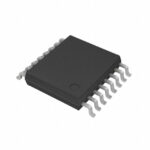 BU8763FV-E2

The activity of extra discounts on wholesale prices is in full swing…
Please fill in your contact information and we will send you the latest wholesale price list.






