 ChipApex | Global Electronic Components Supplier
SEARCH
Search Product
Search Post
— IC芯片 | 连接器 | 传感器 | 被动器件 —
Search productSearch post
— IC芯片 | 连接器 | 传感器 | 被动器件 —
Consult the customer manager about the wholesale price.
consultation hotline:86-132-6715-2157
email:[email protected]
Contact the product manager for consultation. One-stop consultation is available.
Do you want a lower wholesale price? Please send us your inquiry and we will reply immediately.
The BYG10G-M3/TR3 is a standard recovery rectifier diode manufactured by Vishay General Semiconductor. It features a 1.5 A average forward current rating and a 400 V maximum repetitive reverse voltage. The device utilizes a DO-214AC (SMA) surface-mount package with glass passivation for the junction. Key electrical characteristics include a maximum non-repetitive peak surge current of 30 A, a typical reverse leakage current of 1 µA, and a maximum forward voltage drop of 1.15 V. It operates within a junction temperature range of -55 °C to +150 °C.
Verify the specific suffix configuration against official Vishay documentation to confirm compliance status and qualification grade. Ensure the ordering part number matches the required RoHS directive adherence and AEC-Q101 automotive qualification if applicable. Cross-reference the manufacturer datasheet for any recent product change notices or environmental compliance updates prior to final procurement decisions.
Select this component for designs requiring robust standard recovery performance in compact surface-mount layouts. The 1.5 A current capacity and 400 V blocking voltage suit general-purpose AC-DC conversion tasks. Consider the thermal management requirements associated with the SMA package footprint and the specified maximum junction temperature limits during circuit simulation.
This device belongs to the BYG10 series of silicon planar fast recovery rectifiers designed for surface-mount applications. The series offers a range of voltage ratings from 200 V to 1600 V while maintaining consistent mechanical dimensions. The M3 suffix typically indicates lead-free construction compliant with international environmental standards, distinguishing it from older commercial-grade variants.
Direct substitutes within the same family include BYG10D-M3/TR3 (200 V) and BYG10H-M3/TR3 (600 V), provided voltage ratings align with circuit requirements. Verify that alternative components match the DO-214AC package outline and thermal characteristics to ensure physical compatibility without redesigning the PCB footprint.
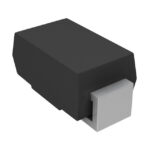 BYG10G-M3/TR3
The activity of extra discounts on wholesale prices is in full swing…
Please fill in your contact information and we will send you the latest wholesale price list.







