 ChipApex | Global Electronic Components Supplier
SEARCH
Search Product
Search Post
— IC芯片 | 连接器 | 传感器 | 被动器件 —
Search productSearch post
— IC芯片 | 连接器 | 传感器 | 被动器件 —
Consult the customer manager about the wholesale price.
consultation hotline:86-132-6715-2157
email:[email protected]
Contact the product manager for consultation. One-stop consultation is available.
Do you want a lower wholesale price? Please send us your inquiry and we will reply immediately.
The BYS10-35-M3/TR is a surface-mount Schottky barrier rectifier from Vishay General Semiconductor, housed in an SMA (DO-214AC) package. It features a maximum repetitive peak reverse voltage of 35 V and a maximum average forward rectified current of 1.5 A. The device exhibits a low instantaneous forward voltage of 500 mV at 1.0 A and supports a peak forward surge current of 40 A. Operating junction temperatures range from -65 °C to +150 °C, with a thermal resistance junction-to-lead of 25 °C/W.
Verify the specific ordering code suffix against the manufacturer's official documentation to confirm compliance status and packaging details. Ensure the selected variant matches the required voltage rating and thermal characteristics for the intended application environment. Cross-reference the document number and revision date to access the most current technical specifications and mechanical data before finalizing procurement decisions.
Select this component for applications requiring low forward voltage drop and fast switching speeds in compact surface-mount designs. The SMA package offers space-saving benefits while maintaining adequate thermal performance through lead-based heat dissipation. Consider the 35 V reverse voltage rating relative to circuit operating conditions to ensure sufficient margin against transient spikes and steady-state reverse bias requirements.
This device belongs to the BYS10 series of surface-mount Schottky barrier rectifiers manufactured by Vishay General Semiconductor. The series includes variants with different reverse voltage ratings, such as 25 V and 45 V options, all sharing similar electrical characteristics and mechanical form factors. The M3 suffix indicates a halogen-free, RoHS-compliant commercial grade product suitable for modern electronics manufacturing processes.
Compatible substitutes within the same family include BYS10-25-M3/TR and BYS10-45-M3/TR, which share identical package dimensions and general electrical profiles but differ in maximum repetitive peak reverse voltage ratings. Verify that the alternative part's voltage rating meets or exceeds the circuit requirements when substituting.
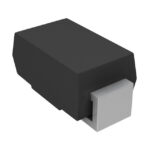 BYS10-35-M3/TR
The activity of extra discounts on wholesale prices is in full swing…
Please fill in your contact information and we will send you the latest wholesale price list.






