 ChipApex | Global Electronic Components Supplier
SEARCH
Search Product
Search Post
— IC芯片 | 连接器 | 传感器 | 被动器件 —
Search productSearch post
— IC芯片 | 连接器 | 传感器 | 被动器件 —
Consult the customer manager about the wholesale price.
consultation hotline:86-132-6715-2157
email:[email protected]
Contact the product manager for consultation. One-stop consultation is available.
Do you want a lower wholesale price? Please send us your inquiry and we will reply immediately.
The BYT54A-TAP is a fast avalanche sinterglass diode manufactured by Vishay General Semiconductor - Diodes Division. It features a 50 V reverse voltage rating and a 1.25 A average forward current capability in the SOD-57 surface-mount package. The device exhibits a maximum forward voltage of 1.5 V at rated current and a low reverse leakage current of 5 µA. With a peak surge current capacity of 30 A and a recovery time of 100 ns, it supports efficient power conversion. Operating temperatures range from -55°C to +175°C junction temperature.
Verify the specific suffix 'TAP' corresponds to the tape-and-reel packaging format required for automated assembly processes. Confirm that the SOD-57 footprint matches the target PCB design guidelines. Ensure compliance with RoHS directives if applicable to the final product regulations. Cross-reference the manufacturer's latest datasheet revision to confirm pinout consistency before integration into production designs.
Select this component when a compact surface-mount solution is required for medium-current applications up to 1.25 A. The 50 V rating suits low-voltage DC systems. Consider the 100 ns recovery time for switching frequencies where standard rectifiers may exhibit excessive losses. The SOD-57 package offers space savings compared to through-hole alternatives like DO-41 while maintaining similar electrical performance profiles.
This part belongs to the BYT54 series of fast avalanche sinterglass diodes from Vishay. The series includes variants with different reverse voltage ratings, such as BYT54B (100 V) and BYT54D (200 V), all sharing the same 1.25 A current rating and SOD-57 package. These devices are designed for general-purpose rectification where speed and reliability are prioritized over ultra-low forward voltage drops.
Direct substitutes include other 50 V, 1.25 A fast recovery diodes in the SOD-57 package from manufacturers like STMicroelectronics or ON Semiconductor. Verify equivalent forward voltage and reverse leakage specifications to ensure circuit compatibility. Check if alternative brands offer improved thermal resistance or lower capacitance if signal integrity is critical.
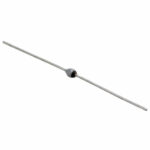 BYT54A-TAP
The activity of extra discounts on wholesale prices is in full swing…
Please fill in your contact information and we will send you the latest wholesale price list.





