 ChipApex | Global Electronic Components Supplier
SEARCH
Search Product
Search Post
— IC芯片 | 连接器 | 传感器 | 被动器件 —
Search productSearch post
— IC芯片 | 连接器 | 传感器 | 被动器件 —
Consult the customer manager about the wholesale price.
consultation hotline:86-132-6715-2157
email:[email protected]
Contact the product manager for consultation. One-stop consultation is available.
Do you want a lower wholesale price? Please send us your inquiry and we will reply immediately.
The BYV37-TAP is a fast recovery rectifier diode manufactured by Vishay General Semiconductor - Diodes Division. It features an 800 V reverse voltage rating and a 2 A average forward current capability. The device utilizes a single configuration within the SOD-57 through-hole package. Key electrical parameters include a maximum surge current of 50 A, a reverse leakage current of up to 5 uA, and a typical forward voltage of 1.1 V. The component supports a wide operating temperature range from -55 °C to +175 °C and exhibits a soft recovery characteristic with a recovery time of approximately 300 ns.
Verify the specific suffix TAP indicates the ammo pack packaging format as documented by the manufacturer. Confirm the SOD-57 through-hole package type matches your board design requirements. Ensure the 800 V reverse voltage rating aligns with your circuit's peak inverse voltage demands. Cross-reference the datasheet for exact thermal resistance values if junction temperature calculations are required for your specific application environment.
Select this component when high-temperature operation up to 175 °C is necessary. The 800 V rating suits medium-voltage AC-DC conversion stages. The SOD-57 package offers a compact solution for through-hole assembly compared to larger axial leads. Consider the 300 ns recovery time for frequencies where standard rectifiers may exhibit excessive losses. The 2 A continuous current rating defines the load capacity limits for steady-state operation.
The BYV37-TAP belongs to the BYV series of power rectifiers designed for general-purpose applications. This series emphasizes fast recovery characteristics to minimize switching losses. The TAP suffix specifically denotes the tape-and-reel or ammo pack delivery method, distinct from bulk packaging options. Vishay positions these diodes for use in environments requiring reliable performance under high thermal stress.
The BYW36-TAP serves as a related alternative within the same manufacturer portfolio, offering similar current ratings but with a lower 600 V reverse voltage specification. Verify that the reduced voltage rating of the substitute meets the specific circuit requirements before implementation.
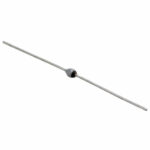 BYV37-TAP
The activity of extra discounts on wholesale prices is in full swing…
Please fill in your contact information and we will send you the latest wholesale price list.





