 ChipApex | Global Electronic Components Supplier
SEARCH
Search Product
Search Post
— IC芯片 | 连接器 | 传感器 | 被动器件 —
Search productSearch post
— IC芯片 | 连接器 | 传感器 | 被动器件 —
Consult the customer manager about the wholesale price.
consultation hotline:86-132-6715-2157
email:[email protected]
Contact the product manager for consultation. One-stop consultation is available.
Do you want a lower wholesale price? Please send us your inquiry and we will reply immediately.
The Nexperia BZB84-B8V2-QR is a dual voltage regulator diode in the BZB84-Q series, housed in an SOT-23 (TO-236AB) surface-mounted plastic package. It features a dual common anode configuration with two independent Zener diodes sharing a single anode terminal. The device provides a nominal working voltage of 8.2 V with a tight tolerance of ±2%. Qualified according to AEC-Q101 standards, it supports automotive applications with a total power dissipation of 300 mW and a non-repetitive peak reverse power dissipation of 40 W per diode. Operating temperatures range from -55 °C to +150 °C.
Verify the specific ordering suffix against the manufacturer's current catalog to ensure correct packaging and tape-and-reel specifications. Confirm that the component meets the required AEC-Q101 qualification status for your target application environment. Cross-reference the marking code VP% on the physical device to validate authenticity and traceability during incoming inspection processes.
Select this component when a dual Zener solution with shared anode topology is required in a minimal footprint. The ±2% tolerance variant is appropriate for precision regulation tasks where tighter voltage accuracy is necessary compared to standard ±5% options. Ensure the thermal management design accommodates the 300 mW total power dissipation limit within the specified ambient temperature range.
This part belongs to the Nexperia BZB84-Q series, which offers a comprehensive range of dual Zener diodes in the SOT-23 package. The series covers nominal voltages from 2.4 V to 75 V, providing designers with flexible options for various regulation needs. The 'Q' designation indicates automotive qualification, distinguishing it from standard commercial grade variants within the broader BZB84 family.
Direct replacements include other BZB84-Q series parts with identical pinout and similar electrical characteristics, such as BZB84-C8V2-Q for looser tolerance requirements. Single-channel equivalents like BZX84-B8V2-QR may be used if only one diode is needed, though this increases board space consumption.
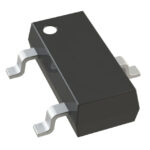 BZB84-B8V2-QR
The activity of extra discounts on wholesale prices is in full swing…
Please fill in your contact information and we will send you the latest wholesale price list.




