 ChipApex | Global Electronic Components Supplier
SEARCH
Search Product
Search Post
— IC芯片 | 连接器 | 传感器 | 被动器件 —
Search productSearch post
— IC芯片 | 连接器 | 传感器 | 被动器件 —
Consult the customer manager about the wholesale price.
consultation hotline:86-132-6715-2157
email:[email protected]
Contact the product manager for consultation. One-stop consultation is available.
Do you want a lower wholesale price? Please send us your inquiry and we will reply immediately.
The Nexperia BZB84-C2V7-QR is a dual voltage regulator diode in the BZB84-Q series, housed in an SOT-23 (TO-236AB) surface-mount package. It features a dual common anode configuration with two independent cathodes. The device provides a nominal Zener voltage of 2.7 V with a tolerance of approximately ±5 %. Total power dissipation is rated at 300 mW, while non-repetitive peak reverse power dissipation reaches 40 W. Operating junction temperature ranges from -55 °C to +150 °C. Reverse current is specified at 20 μA maximum at IZ = 5 mA, and differential resistance is 100 Ω.
Verify the specific ordering suffix against the manufacturer's latest documentation to ensure correct tolerance and packaging specifications. Confirm that the component meets the required AEC-Q101 qualification status for your intended application environment. Cross-reference the marking code UA% on the physical device to validate authenticity and part identity before integration into production lines.
Select this component when a dual common anode topology is required within a small SOT-23 footprint. The C-series tolerance of approximately ±5 % suits general regulation tasks where tight voltage precision is not critical. Ensure the total power dissipation of 300 mW aligns with the thermal management capabilities of the target PCB layout and operating ambient conditions.
This device belongs to the Nexperia BZB84-Q series, which offers a comprehensive range of dual Zener diodes for automotive and industrial use. The series includes various voltage options from 2.4 V to 75 V in both B (±2 %) and C (±5 %) tolerance grades. All variants share the same SOT-23 package and pinout, simplifying inventory management for designs utilizing multiple voltage references.
Direct substitutes within the same family include BZB84-B2V7-Q (tighter ±2 % tolerance) or other BZB84-Q series parts with identical pinouts. Non-series replacements must match the SOT-23 package, 300 mW power rating, and dual common anode configuration while verifying electrical parameters like Zener voltage and leakage current.
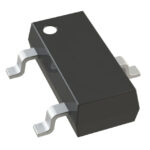 BZB84-C2V7-QR
The activity of extra discounts on wholesale prices is in full swing…
Please fill in your contact information and we will send you the latest wholesale price list.




