 ChipApex | Global Electronic Components Supplier
SEARCH
Search Product
Search Post
— IC芯片 | 连接器 | 传感器 | 被动器件 —
Search productSearch post
— IC芯片 | 连接器 | 传感器 | 被动器件 —
Consult the customer manager about the wholesale price.
consultation hotline:86-132-6715-2157
email:[email protected]
Contact the product manager for consultation. One-stop consultation is available.
Do you want a lower wholesale price? Please send us your inquiry and we will reply immediately.
The C8051F017 is a mixed-signal System-on-Chip microcontroller from Silicon Labs, featuring a high-speed CIP-51 core operating at up to 25 MIPS with a 25 MHz clock. It integrates 32 KB of ISP Flash memory and 256 bytes of internal SRAM. The device includes a 10-bit SAR ADC with programmable throughput up to 100 ksps, two 12-bit DACs, and two analog comparators. Digital peripherals consist of hardware SMBus, SPI, and UART interfaces alongside a Programmable Counter Array. It operates on a supply voltage of 2.7V to 3.6V within an industrial temperature range of -40°C to +85°C.
Verify the specific package variant (TQFP-64, TQFP-48, or LQFP-32) required for your design, as the datasheet covers multiple form factors for this part number. Confirm RoHS compliance status and ensure the ordering suffix matches the desired temperature grade and packaging style. Cross-reference the pinout diagrams in the official documentation to validate footprint compatibility before finalizing procurement.
Select the C8051F017 when a design requires a balance of moderate code space and integrated analog peripherals. This model is suitable for applications needing 10-bit ADC resolution rather than the 12-bit version found in the F00x series. Consider this part if the project benefits from the specific 256-byte RAM configuration and does not require the larger memory capacity of the F005/06/07 variants.
This component belongs to the C8051F0xx family of mixed-signal MCUs, which are distinguished by their high integration levels and ISP Flash technology. The F017 variant specifically differentiates itself within the family by offering 10-bit ADC resolution compared to the 12-bit resolution of the F00x counterparts, while sharing the same 32 KB Flash and core architecture.
C8051F010: Offers identical specifications but with 10-bit ADC resolution instead of 12-bit. C8051F012: Provides the same core and memory but with 10-bit ADC resolution. C8051F007: Features 12-bit ADC resolution and 2304 bytes of RAM, requiring software adaptation for memory differences.
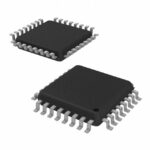 C8051F017
The activity of extra discounts on wholesale prices is in full swing…
Please fill in your contact information and we will send you the latest wholesale price list.







