 ChipApex | Global Electronic Components Supplier
SEARCH
Search Product
Search Post
— IC芯片 | 连接器 | 传感器 | 被动器件 —
Search productSearch post
— IC芯片 | 连接器 | 传感器 | 被动器件 —
Consult the customer manager about the wholesale price.
consultation hotline:86-132-6715-2157
email:[email protected]
Contact the product manager for consultation. One-stop consultation is available.
Do you want a lower wholesale price? Please send us your inquiry and we will reply immediately.
The C8051F046 is an 8-bit microcontroller from Silicon Labs, featuring a CIP-51 core with up to 25 MIPS throughput at 25 MHz. It includes 32 kB of in-system programmable Flash memory and 4352 bytes of internal data RAM. The device integrates a 10-bit SAR ADC with 13 external inputs, three analog comparators, and a precision voltage reference. Digital peripherals include a Bosch CAN 2.0B controller, hardware SMBus, SPI, two UARTs, a PCA, and five general-purpose timers. It operates on a 2.7 V to 3.6 V supply within the -40 °C to +85 °C temperature range.
Verify the specific package variant (TQFP-100 or TQFP-64) required for your design, as pinouts differ between configurations. Confirm that the 32 kB Flash capacity meets your application's code storage needs, distinguishing it from the 64 kB variants in the same family. Ensure your development environment supports the CIP-51 instruction set and JTAG debugging protocols specified in the datasheet.
Select this component when a dedicated CAN controller is necessary alongside mixed-signal processing capabilities. The C8051F046 is suitable for designs prioritizing deterministic real-time performance through its high-throughput core. Consider the available GPIO count and peripheral allocation against your system requirements, noting that the 10-bit ADC resolution is fixed for this specific model compared to other family members.
This device belongs to the C8051F04x/7x series of fully integrated mixed-signal System-on-Chip microcontrollers. It shares the common CIP-51 core architecture and peripheral set found across the family, differentiated primarily by memory size and ADC resolution. The C8051F046 specifically offers a balance of moderate Flash capacity and high-performance analog features within the industrial-grade temperature range.
The C8051F045 serves as a direct functional substitute within the same package options, offering identical specifications except for increased 64 kB Flash memory. Other family members like the C8051F040 provide higher resolution ADCs but may require software adjustments due to different peripheral configurations.
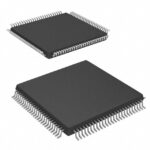 C8051F046
The activity of extra discounts on wholesale prices is in full swing…
Please fill in your contact information and we will send you the latest wholesale price list.







