 ChipApex | Global Electronic Components Supplier
SEARCH
Search Product
Search Post
— IC芯片 | 连接器 | 传感器 | 被动器件 —
Search productSearch post
— IC芯片 | 连接器 | 传感器 | 被动器件 —
Consult the customer manager about the wholesale price.
consultation hotline:86-132-6715-2157
email:[email protected]
Contact the product manager for consultation. One-stop consultation is available.
Do you want a lower wholesale price? Please send us your inquiry and we will reply immediately.
The C8051F063-GQR is an 8-bit microcontroller from the Silicon Labs C8051F06x family, featuring a high-speed pipelined 8051 core operating at up to 24.5 MHz with 25 MIPS throughput. It integrates 64 kB of in-system programmable Flash memory and 4352 bytes of internal data RAM. The device includes two 16-bit SAR ADCs, a 10-bit SAR ADC, two 12-bit DACs, three analog comparators, and a precision voltage reference. Digital peripherals comprise a Bosch CAN 2.0B controller, hardware SMBus, SPI, and dual UARTs. It utilizes a 64-pin TQFP package and operates within a supply voltage range of 2.7 V to 3.6 V across a temperature range of -40°C to +85°C.
Verify component authenticity through authorized distribution channels. Confirm package integrity and pin alignment against the 64-pin TQFP specification. Ensure environmental compliance documentation matches project requirements. Review datasheet revision history for any functional updates or errata applicable to this specific manufacturing lot before integration into final designs.
Select this component when high-resolution analog conversion and CAN communication are required in a single chip. The 64-pin TQFP package suits space-constrained designs compared to the 100-pin variants. Consider the 2.7 V to 3.6 V supply constraint for power management. Evaluate the 24.5 MHz clock speed against processing demands. Verify that the 24 general-purpose I/O pins meet interface requirements.
This part belongs to the C8051F06x series of fully integrated mixed-signal microcontrollers. The family shares a common CIP-51 core architecture but varies in pin count, I/O availability, and peripheral configurations. The C8051F063 specifically targets applications needing CAN support and high-resolution ADCs in a compact form factor. It represents a complete system-on-chip solution reducing external component count.
Consult official Silicon Labs documentation for current lifecycle status. Check for recommended upgrades within the C8051F06x family or newer generations. Verify pin compatibility and peripheral equivalence if substituting with other 8-bit MCUs. Review end-of-life notifications for potential supply constraints.
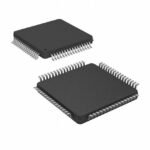 C8051F063-GQR
The activity of extra discounts on wholesale prices is in full swing…
Please fill in your contact information and we will send you the latest wholesale price list.






