 ChipApex | Global Electronic Components Supplier
SEARCH
Search Product
Search Post
— IC芯片 | 连接器 | 传感器 | 被动器件 —
Search productSearch post
— IC芯片 | 连接器 | 传感器 | 被动器件 —
Consult the customer manager about the wholesale price.
consultation hotline:86-132-6715-2157
email:[email protected]
Contact the product manager for consultation. One-stop consultation is available.
Do you want a lower wholesale price? Please send us your inquiry and we will reply immediately.
The C8051F500-IQR is an automotive-grade mixed-signal microcontroller from Silicon Labs, part of the C8051F50x family. It features a high-speed 8051 core operating at up to 50 MHz with pipelined architecture. The device includes 64 kB of in-system programmable Flash memory and 4352 bytes of internal data RAM. Key peripherals include a 12-bit ADC supporting up to 200 ksps with 32 external inputs, two voltage comparators, CAN 2.0 and LIN 2.1 controllers, SMBus, SPI, and UART interfaces. It operates within a supply voltage range of 1.8 V to 5.25 V and supports temperatures from -40 °C to +125 °C.
Verify component authenticity through authorized distributors or Silicon Labs directly. Confirm the specific suffix matches the required package variant. Check official documentation for current lifecycle status as this series may be marked not recommended for new designs. Ensure environmental compliance requirements align with project specifications before finalizing procurement orders.
Select this model when automotive reliability and integrated communication protocols are critical. The inclusion of both CAN and LIN controllers simplifies board design for vehicle networks. Consider the 64 kB Flash capacity against application code size requirements. Evaluate the 12-bit ADC resolution and speed against sensor signal processing needs. Verify that the 48-pin QFP/QFN package fits the physical constraints of the target enclosure.
This component belongs to the C8051F50x/F51x mixed-signal ISP Flash MCU family. It shares architectural similarities with other members like the C8051F501 and C8051F505 but differs in memory configuration and peripheral availability. The family emphasizes high integration by combining analog and digital peripherals on a single chip, reducing external component count.
Silicon Labs recommends the EFM8BB31F64I-QFN32 as a replacement. Note that this alternative utilizes a different architecture and pinout, requiring significant hardware and software redesign rather than being a direct drop-in substitute.
No, the device integrates a precise internal 24 MHz oscillator specifically designed for CAN and master LIN operation, eliminating the need for an external crystal for these protocols.
The 12-bit Analog-to-Digital Converter supports a maximum sampling rate of 200 ksps.
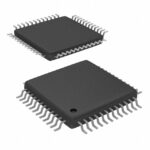 C8051F500-IQR
The activity of extra discounts on wholesale prices is in full swing…
Please fill in your contact information and we will send you the latest wholesale price list.





