 ChipApex | Global Electronic Components Supplier
SEARCH
Search Product
Search Post
— IC芯片 | 连接器 | 传感器 | 被动器件 —
Search productSearch post
— IC芯片 | 连接器 | 传感器 | 被动器件 —
Consult the customer manager about the wholesale price.
consultation hotline:86-132-6715-2157
email:[email protected]
Contact the product manager for consultation. One-stop consultation is available.
Do you want a lower wholesale price? Please send us your inquiry and we will reply immediately.
The CD4013BF is a CMOS dual D-type flip-flop manufactured by Texas Instruments. It contains two independent, identical flip-flops within a single package. Each flip-flop features separate data (D), set (S), and reset (R) inputs, along with complementary Q and /Q outputs. The device operates on positive edge triggering. It supports a wide supply voltage range from 3V to 18V and functions reliably across an extended temperature range of -55°C to 125°C. The component is housed in a 14-pin Ceramic Dual In-Line Package (CDIP).
Verify the package type matches the required 14-pin CDIP specification. Confirm the manufacturer is Texas Instruments to ensure compatibility with standard CD4000 series logic levels. Check for military-grade variants if environmental ruggedness is required. Ensure the order quantity aligns with tube packaging standards typical for ceramic DIP components. Validate the revision status against current datasheets to confirm active production status.
Select this component when dual independent D-type storage is needed in a robust ceramic package. It is suitable for designs requiring high noise immunity and wide voltage tolerance. Consider the CDIP form factor for through-hole mounting or high-reliability applications. Compare propagation delays and power consumption against other CMOS families if speed or efficiency is critical. Ensure input voltage levels are compatible with the system logic family.
The CD4013BF belongs to the CD4000B series of CMOS digital logic devices. This series is known for low power consumption and high noise immunity. The BF suffix specifically denotes the 14-pin ceramic dual in-line package variant. It is part of a broader family that includes plastic DIP and surface-mount options. The device complements other CD4000 series elements like inverters and gates for complex logic design.
Equivalent parts include CD4013BE (plastic DIP) and CD4013BM (SOIC) for pin-compatible alternatives. Military versions such as CD4013B-MIL offer enhanced reliability specifications. Verify package dimensions and thermal characteristics when substituting between ceramic and plastic variants. Ensure functional equivalence regarding setup and hold times for critical timing applications.
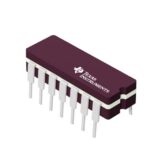 CD4013BF
The activity of extra discounts on wholesale prices is in full swing…
Please fill in your contact information and we will send you the latest wholesale price list.





