 ChipApex | Global Electronic Components Supplier

SEARCH
Search Product
Search Post
— IC芯片 | 连接器 | 传感器 | 被动器件 —
Search productSearch post
— IC芯片 | 连接器 | 传感器 | 被动器件 —
Consult the customer manager about the wholesale price.
consultation hotline:86-132-6715-2157
email:[email protected]
Contact the product manager for consultation. One-stop consultation is available.
Do you want a lower wholesale price? Please send us your inquiry and we will reply immediately.
The CD40174BE is a CMOS Hex D-Type Flip-Flop manufactured by Texas Instruments, belonging to the 4000B series. It features six independent D-type flip-flops within a single 16-pin PDIP package designed for through-hole mounting. The device operates on a supply voltage ranging from 3V to 18V and supports a maximum clock frequency of 16 MHz at 15V. It functions with non-inverting outputs and includes a master reset input. The component is rated for an operating temperature range from -55°C to +125°C.
Verify that the specific part number matches the required 16-pin PDIP package configuration for through-hole assembly. Confirm that the manufacturer designation corresponds to Texas Instruments to ensure compatibility with standard 4000B series electrical characteristics. Check for RoHS compliance status if environmental regulations apply to the final product assembly. Ensure the supplier provides valid traceability documentation for the component batch.
Select this component when a design requires multiple synchronized storage elements within a compact footprint. The choice is appropriate for applications needing parallel data retention or serial shifting capabilities using standard CMOS logic levels. Consider the 16-pin DIP form factor if PCB layout constraints favor through-hole technology over surface mount alternatives. Evaluate the 16 MHz speed limit against the system clock requirements to ensure reliable switching performance.
This device is part of the widely used 4000B series of CMOS logic integrated circuits produced by Texas Instruments. The series is known for its high noise immunity and broad operating voltage range, making it suitable for various general-purpose digital applications. The CD40174BE specifically addresses the need for multi-bit storage within this family, offering a cost-effective solution for complex logic designs requiring multiple flip-flops.
The CD40174BPWR is listed as a direct replacement option, differing primarily in the TSSOP-16 surface-mount package instead of the PDIP-16 through-hole variant. Designers must verify pinout compatibility and physical board space constraints when substituting between these package types.
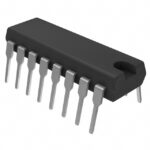 CD40174BE

The activity of extra discounts on wholesale prices is in full swing…
Please fill in your contact information and we will send you the latest wholesale price list.






