 ChipApex | Global Electronic Components Supplier
SEARCH
Search Product
Search Post
— IC芯片 | 连接器 | 传感器 | 被动器件 —
Search productSearch post
— IC芯片 | 连接器 | 传感器 | 被动器件 —
Consult the customer manager about the wholesale price.
consultation hotline:86-132-6715-2157
email:[email protected]
Contact the product manager for consultation. One-stop consultation is available.
Do you want a lower wholesale price? Please send us your inquiry and we will reply immediately.
The CD40174BEE4 is a CMOS Hex D-Type Flip-Flop manufactured by Texas Instruments, belonging to the 4000B series. It integrates six independent D-type flip-flops within a single package, featuring positive-edge triggering and non-inverting outputs. The device operates on a supply voltage range of 3V to 18V and supports surface-mount installation in a 16-SOIC (0.154 inch width) package. Key electrical specifications include a propagation delay of 100ns at 15V with 50pF load, a clock frequency of 16 MHz, and static current consumption of 4 µA. It functions within an ambient temperature range of -55°C to 125°C.
Verify the specific suffix EE4 indicates RoHS compliance and lead-free manufacturing status as per Texas Instruments documentation. Confirm the package variant matches the required 16-SOIC footprint dimensions. Ensure the operating temperature range meets the environmental requirements of the target application. Cross-reference the manufacturer part number with authorized distributors to guarantee authenticity and traceability.
Select this component when a hex configuration of D-type flip-flops is required in a compact surface-mount package. It is suitable for designs needing wide voltage tolerance and industrial temperature stability. Compare against similar 4000B series devices if pin compatibility or specific timing parameters differ. Ensure the input capacitance and output drive capabilities align with the connected circuit loads.
The CD40174BEE4 is part of the Texas Instruments 4000B series of CMOS logic devices. This series is known for broad supply voltage ranges and robust performance across industrial temperatures. The device serves as a fundamental building block for sequential logic circuits, offering a reliable solution for storing binary data in digital systems.
Direct substitutes include the CD40174BM96 and CD40174BPWR, which share identical logical functionality and pinout configurations. Verify that alternative packages such as TSSOP or SOIC variants meet the mechanical constraints of the design.
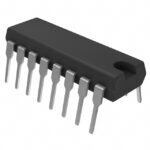 CD40174BEE4
The activity of extra discounts on wholesale prices is in full swing…
Please fill in your contact information and we will send you the latest wholesale price list.





