 ChipApex | Global Electronic Components Supplier
SEARCH
Search Product
Search Post
— IC芯片 | 连接器 | 传感器 | 被动器件 —
Search productSearch post
— IC芯片 | 连接器 | 传感器 | 被动器件 —
Consult the customer manager about the wholesale price.
consultation hotline:86-132-6715-2157
email:[email protected]
Contact the product manager for consultation. One-stop consultation is available.
Do you want a lower wholesale price? Please send us your inquiry and we will reply immediately.
The CD4076BE is a quad D-type flip-flop belonging to the 4000/14000/40000 series of CMOS logic devices. It features four independent positive edge-triggered D flip-flops with true outputs and hold mode functionality. The device operates within a supply voltage range of 3 V to 18 V and supports a maximum frequency of 3 MHz at nominal supply. It utilizes a 16-pin PDIP package, offers a load capacitance of 50 pF, and functions reliably across an extended temperature range from -55 °C to +125 °C.
Verify component authenticity by checking manufacturer markings against official datasheet specifications. Confirm that the part number matches the exact Harris Corporation designation. Ensure the physical package corresponds to the specified 16-pin DIP configuration. Validate operational parameters such as voltage and temperature ranges against project requirements before integration.
Select this component when designing circuits requiring multiple synchronized storage elements with precise timing control. The positive edge triggering ensures reliable data capture at specific clock transitions. Consider the wide operating voltage range for compatibility with various power supply architectures. Evaluate the hold mode feature if temporary data preservation without clock activity is necessary for the system design.
This device is part of the extensive 4000 series family of CMOS logic integrated circuits. It provides standard digital storage functionality compatible with other members of the series. The design follows established industry standards for quad D flip-flops, ensuring interoperability within broader logic systems utilizing similar CMOS technology families.
Cross-reference equivalent parts from other manufacturers offering identical pinouts and logical functions. Verify that substitute components maintain the same 16-pin DIP package dimensions. Ensure replacement devices support the required 3 V to 18 V operating voltage range. Confirm that alternative sources provide comparable performance characteristics regarding speed and temperature stability.
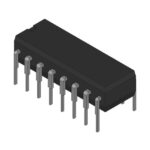 CD4076BE
The activity of extra discounts on wholesale prices is in full swing…
Please fill in your contact information and we will send you the latest wholesale price list.





