 ChipApex | Global Electronic Components Supplier
SEARCH
Search Product
Search Post
— IC芯片 | 连接器 | 传感器 | 被动器件 —
Search productSearch post
— IC芯片 | 连接器 | 传感器 | 被动器件 —
Consult the customer manager about the wholesale price.
consultation hotline:86-132-6715-2157
email:[email protected]
Contact the product manager for consultation. One-stop consultation is available.
Do you want a lower wholesale price? Please send us your inquiry and we will reply immediately.
The CD54HC273F is a high-speed CMOS logic octal D-type flip-flop manufactured by Texas Instruments. It features eight D-type flip-flops with positive-edge triggering and an asynchronous master reset input. The device operates within a supply voltage range of 2V to 6V and supports data rates up to 20 MHz. It provides buffered inputs and offers standard output drive capabilities of 10 LSTTL loads, or 15 LSTTL loads in bus driver configurations. The component is designed for military-grade reliability, operating across an extended temperature range of -55°C to 125°C.
Verify the specific suffix 'F' indicates the 20-lead ceramic dual in-line package (CDIP). Confirm that the order specifies the military-grade variant required for -55°C to 125°C operation. Ensure compatibility with existing board layouts for the CDIP footprint. Check for lead-free compliance if required by specific project standards, although military parts may have distinct regulatory considerations.
Select this component when military-grade environmental tolerance is mandatory. The CD54HC273F is appropriate for applications requiring robust performance in extreme temperatures where commercial variants would fail. Consider the physical size constraints of the CDIP package compared to surface-mount alternatives like the SOIC version. Ensure the system design accommodates the power dissipation characteristics of the ceramic package.
This part belongs to the HC (High-speed CMOS) logic family from Texas Instruments. It is the military-grade counterpart to commercial variants such as the CD74HC273. While sharing identical logical functionality, the CD54HC273F differs in packaging material and thermal resilience. It serves as a direct replacement for older TTL-based octal registers in modern CMOS designs requiring high noise immunity.
The device uses positive-edge triggering, meaning data is captured at the rising edge of the clock signal.
It features an asynchronous master reset input that clears all eight flip-flops independently of the clock signal.
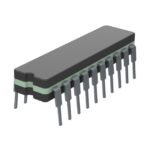 CD54HC273F
The activity of extra discounts on wholesale prices is in full swing…
Please fill in your contact information and we will send you the latest wholesale price list.






