 ChipApex | Global Electronic Components Supplier

SEARCH
Search Product
Search Post
— IC芯片 | 连接器 | 传感器 | 被动器件 —
Search productSearch post
— IC芯片 | 连接器 | 传感器 | 被动器件 —
Consult the customer manager about the wholesale price.
consultation hotline:86-132-6715-2157
email:[email protected]
Contact the product manager for consultation. One-stop consultation is available.
Do you want a lower wholesale price? Please send us your inquiry and we will reply immediately.
The CD74ACT374E is an octal D-type flip-flop manufactured by Harris Corporation, belonging to the 74ACT logic series. It features positive edge triggering and non-inverting true outputs with tri-state capability. The device operates on a single supply voltage ranging from 4.5V to 5.5V. It provides high-speed performance with a maximum clock frequency of 110MHz and a typical propagation delay of 11.2ns at 5V with a 50pF load. Output drive currents are rated at 24mA for both high and low states, while static current consumption is 8µA. It is housed in a 20-pin PDIP package suitable for through-hole mounting.
Verify manufacturer origin as Harris Corporation or authorized successor entities like Texas Instruments due to historical acquisitions. Confirm RoHS compliance status, as original Harris variants may not meet modern environmental standards. Check datasheet revisions for pinout consistency and electrical parameter updates. Ensure the 20-PDIP package matches PCB footprint requirements before procurement.
Select this component when an octal D-type flip-flop with tri-state outputs is required for high-speed digital logic. The 74ACT series offers faster switching speeds compared to standard 74LS or 74HC families. Ensure the design supports the 4.5V to 5.5V operating range. Consider the 110MHz clock limit and 11.2ns propagation delay for timing analysis. Verify that through-hole mounting is compatible with the assembly process.
The CD74ACT374E is part of the extensive 74ACT family of advanced CMOS logic devices produced by Harris Corporation. This series was designed to bridge the performance gap between older TTL technologies and newer CMOS solutions. The ACT family emphasizes high speed and low power consumption, making it suitable for demanding digital applications. Harris Corporation was a significant player in semiconductor manufacturing before industry consolidations.
CD74ACT374N
The device uses positive edge triggering, meaning data is captured at the rising edge of the clock signal.
No, the outputs are true (non-inverted) and feature tri-state capability.
The maximum supply voltage is 5.5V, with a minimum of 4.5V.
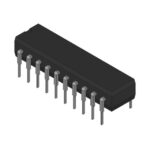 CD74ACT374E

The activity of extra discounts on wholesale prices is in full swing…
Please fill in your contact information and we will send you the latest wholesale price list.






