 ChipApex | Global Electronic Components Supplier

SEARCH
Search Product
Search Post
— IC芯片 | 连接器 | 传感器 | 被动器件 —
Search productSearch post
— IC芯片 | 连接器 | 传感器 | 被动器件 —
Consult the customer manager about the wholesale price.
consultation hotline:86-132-6715-2157
email:[email protected]
Contact the product manager for consultation. One-stop consultation is available.
Do you want a lower wholesale price? Please send us your inquiry and we will reply immediately.
The CD74HCT73M is a dual JK-type flip-flop integrated circuit manufactured by Texas Instruments. It operates within the HCT logic series, utilizing CMOS technology with TTL-compatible inputs. The device features two independent JK flip-flops with negative-edge triggering and an asynchronous reset function. Packaged in a 14-SOIC surface-mount format, it supports a supply voltage range of 4.5 V to 5.5 V. Key electrical specifications include a maximum propagation delay of 38 ns at 4.5 V with 50 pF load, a static current of 4 µA, and output drive capabilities of 4 mA for both high and low states. The component is rated for operation between -55°C and +125°C.
Verify the specific ordering suffix to confirm package type and reel specifications. Ensure compatibility with standard SOIC-14 footprints during PCB layout. Confirm RoHS compliance status through official manufacturer documentation prior to integration. Cross-reference pin assignments with the latest datasheet revision to avoid interface mismatches.
Select this component when dual JK flip-flops with negative-edge triggering are required. The HCT series ensures compatibility with standard TTL logic families. Consider the 14-SOIC package for surface-mount assembly needs. Evaluate the 38 ns propagation delay against system timing requirements. Verify operating temperature range suitability for the intended environment.
This part belongs to the Texas Instruments 74HCT logic family, designed for high-speed CMOS operation with TTL-compatible inputs. The CD74HCT73M specifically provides dual JK flip-flops, distinguishing it from D-type or T-type variants within the same series. It serves as a fundamental building block for sequential logic circuits requiring memory elements with defined set and reset behaviors.
The CD74HCT73M utilizes negative-edge triggering, meaning the state changes occur on the falling edge of the clock signal.
Yes, the device includes an asynchronous reset function that allows immediate clearing of the flip-flop outputs regardless of the clock state.
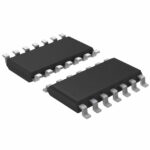 CD74HCT73M

The activity of extra discounts on wholesale prices is in full swing…
Please fill in your contact information and we will send you the latest wholesale price list.





