 ChipApex | Global Electronic Components Supplier
SEARCH
Search Product
Search Post
— IC芯片 | 连接器 | 传感器 | 被动器件 —
Search productSearch post
— IC芯片 | 连接器 | 传感器 | 被动器件 —
Consult the customer manager about the wholesale price.
consultation hotline:86-132-6715-2157
email:[email protected]
Contact the product manager for consultation. One-stop consultation is available.
Do you want a lower wholesale price? Please send us your inquiry and we will reply immediately.
The CRBV55BE-2425-2820 is a Voltage Controlled Oscillator (VCO) manufactured by Crystek Corporation. It operates within a frequency range of 2.425 GHz to 2.82 GHz, with a center frequency of 2622.5 MHz. The device utilizes a tuning voltage range of 0.5 VDC to 18 VDC. Output power is specified at 0 dBm typical, with a harmonic suppression of 0 ±2.5 dBc for the second harmonic. The component is housed in a RedBox package measuring 31.75 mm in length and 14.99 mm in width.
Verify the specific suffix BE against official Crystek documentation to confirm exact tuning curve and performance tolerances. Ensure the required tuning voltage range aligns with available control circuitry capabilities. Confirm package dimensions match PCB layout constraints prior to ordering. Request updated datasheets directly from the manufacturer or authorized distributors to validate current revision status and compliance certifications.
Select this component when a fixed-frequency oscillator is insufficient and voltage-tunable microwave signals are required. Evaluate the 0.5 V to 18 V tuning range against available control voltages. Consider the RedBox package size for spatial constraints. Compare output power requirements against system sensitivity thresholds. Verify that the center frequency of 2622.5 MHz meets the specific application bandwidth needs.
This part belongs to the CRBV55 series of Voltage Controlled Oscillators from Crystek Corporation. The series offers various frequency ranges tailored for different microwave applications. The CRBV55BE-2425-2820 specifically targets the 2.4 GHz to 2.8 GHz spectrum. It shares common mechanical and electrical design principles with other parts in the RedBox family, ensuring consistent mounting and thermal characteristics across the product line.
Direct substitutes include other Crystek VCOs with similar frequency ranges, such as the CRBV55BE-2400-2670 or CRBV55BE-2320-2750. Cross-manufacturer replacements require careful verification of pinout compatibility, tuning voltage ranges, and output power levels. Ensure any alternative component maintains equivalent harmonic suppression and phase noise specifications for the target application.
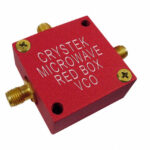 CRBV55BE-2425-2820
The activity of extra discounts on wholesale prices is in full swing…
Please fill in your contact information and we will send you the latest wholesale price list.




