 ChipApex | Global Electronic Components Supplier

SEARCH
Search Product
Search Post
— IC芯片 | 连接器 | 传感器 | 被动器件 —
Search productSearch post
— IC芯片 | 连接器 | 传感器 | 被动器件 —
Consult the customer manager about the wholesale price.
consultation hotline:86-132-6715-2157
email:[email protected]
Contact the product manager for consultation. One-stop consultation is available.
Do you want a lower wholesale price? Please send us your inquiry and we will reply immediately.
The Littelfuse CT-0300-D20 is a general-purpose current transformer designed for industrial applications. It features a donut-style core with a 2-inch (50.8 mm) sensor window, allowing for the measurement of conductors passing through the aperture. The device operates at a voltage rating of 600V and provides a standard current ratio of 300:5. This configuration enables the transformation of primary currents up to 300A into a secondary output of 5A, suitable for connection to ammeters, relays, or monitoring instruments.
Verify critical specifications against the official Littelfuse datasheet before integration. Confirm that the required conductor diameter fits within the 2-inch window and that the system voltage does not exceed the 600V rating. Ensure secondary load impedance matches the transformer's burden requirements to maintain accuracy. Check RoHS compliance status if environmental regulations apply to your specific deployment.
Select this model when a 300A primary current range and 5A secondary output are required. The 2-inch window accommodates larger busbars or cables compared to smaller aperture models. Consider the CT-0300-D10 variant if a 1-inch window suffices for smaller conductors. Verify that the application environment supports the operating temperature range specified in the technical documentation.
This component belongs to Littelfuse’s SymCom series of current transformers, which are engineered for reliable performance in demanding industrial environments. The series offers various ratios and window sizes to accommodate different conductor dimensions and current levels. The CT-0300-D20 specifically addresses high-current measurement needs where robust physical construction and standardized output signals are essential for accurate data acquisition.
Cross-reference with other 300:5 ratio transformers featuring a 2-inch window. Verify mechanical fitment and electrical burden characteristics against alternatives. Ensure replacement units meet the same 600V insulation class and accuracy standards as the original specification.
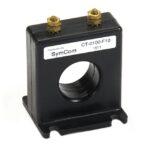 CT-0300-D20

The activity of extra discounts on wholesale prices is in full swing…
Please fill in your contact information and we will send you the latest wholesale price list.





